

Ans: You can explain cybersecurity to a child by defining it as a practice of staying safe online, because it detects and blocks scammers and cyber threats before reaching you.
×
Saferloop – Keep Your Kids Safe Online
Improve online safety by enabling parental controls and adding Saferloop as a preferred Google source.
What is Cybersecurity? Process, Types, and How Cybersecurity Protects Children?
Cybersecurity is the practice of protecting servers, networks, systems, and accounts from hackers and other malicious actors. Also, it plays a critical role in providing an additional layer of protection for children’s safety and privacy.
As a concerned parent, you should stay till the end of this article to acknowledge how online security works, the growth of cyber threats, real-time examples, the importance of cybersecurity, and the role of parental controls.
Table of Contents:
- What is Cybersecurity?
- Why is Cybersecurity Important for Protecting Children?
- Growth of Cyber Threats that Target Children
- Real-Life Examples of Cyber Attacks
- How Does Cybersecurity Work to Protect Kids?
- Basic Key Concepts of Cybersecurity That All Kids and Parents Must Know
- What are the Types of Cybersecurity?
- How are Parental Controls Required for Cybersecurity?
- Wrapping Up!
- Frequently Asked Questions
What is Cybersecurity?
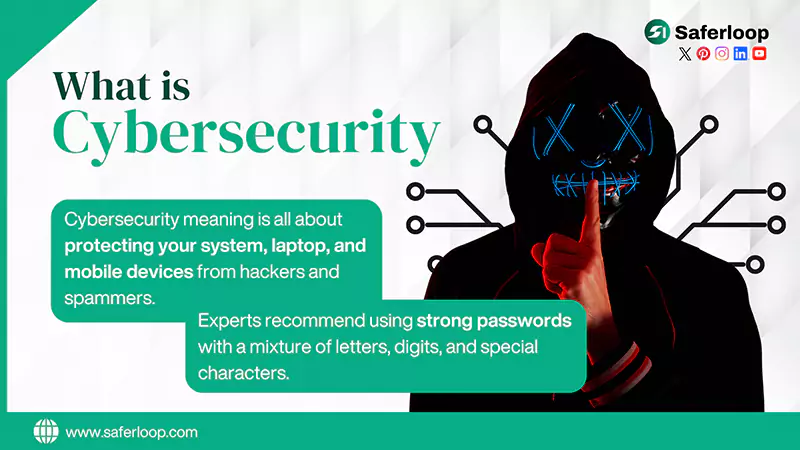
Cybersecurity meaning is all about protecting your system, laptop, and mobile devices from hackers and spammers. So, if you want to protect your and your kids’ Instagram passwords and bank accounts, you will need digital security to ensure everything is secure or in your control.
Also, you might be aware that experts recommend using strong passwords with a mixture of letters, digits, and special characters. It prevents your account from being hijacked by attackers.
Accordingly, you have to implement data security because cybercriminals are becoming more careful to steal your data.
In simple terms, cybersecurity protects your digital devices and personal information from hacking.
Why is Cybersecurity Important for Protecting Children?
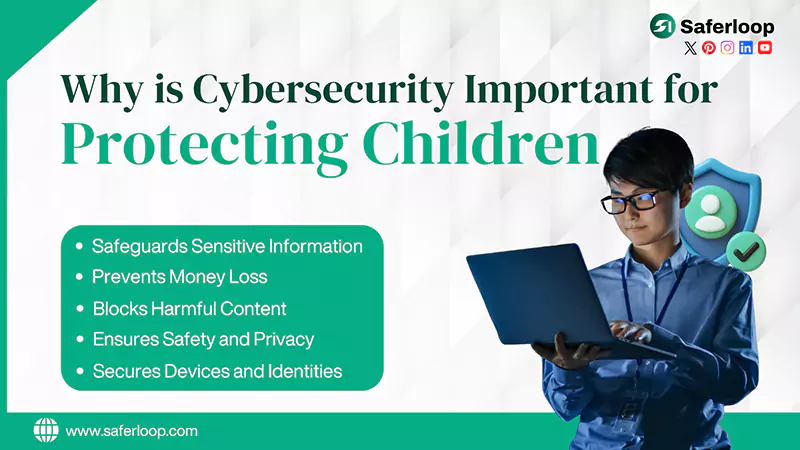
Cybersecurity is important for protecting children because it safeguards their sensitive information, prevents money loss, blocks harmful content, ensures safety and privacy, and secures devices and identities.
Here, I’ve mentioned the top five reasons to figure out why cybersecurity is important for children in this digital era.
1. Safeguards Sensitive Information
When your little ones browse online websites or apps, they demand personal information, such as name, age, gender, and location, to give access. This increases the chances of hackers targeting them; that’s when cybersecurity comes in. It shields their data, personal records, and other sensitive information from unauthorized access.
2. Prevents Money Loss
Obviously, who hasn’t heard of banking scams? Online security protects your and your children’s bank details from cybercriminals who try to steal money from spammy links and fraudulent calls. It utilizes multi-factor authentication (MFA) to guard your hard-earned money.
3. Blocks Harmful Content
Not only this, but the internet security helps in preventing exposure to harmful content (explicit, adult, violent, and abusive content). By implementing cyber protection, you can block all age-inappropriate content or information.
4. Ensures Safety and Privacy
Usually, the young generation and kids are active on digital platforms and social media, which requires internet security. Hence, successful cybersecurity has multiple layers of protection to safeguard your children and teenagers’ privacy on social media accounts.
5. Secures Devices and Identities
Children are excessively active on digital platforms through Wi-Fi and family networks, which increases the possibility of data theft. So, if your kids use online platforms, they apparently need cybersecurity to shield their IP address and identity.
Growth of Cyber Threats that Target Children
Child grooming and cyber threats are rising beyond expectations in 2026. According to the MissingKids.org report, child s*x trafficking cases have increased from 5,976 to 62,891 in 2025. Now, you can imagine how online platforms are misused to target innocent minds.
You can see that everything goes online, from submitting school admissions to applying for a job, raising the cyber threats worldwide.
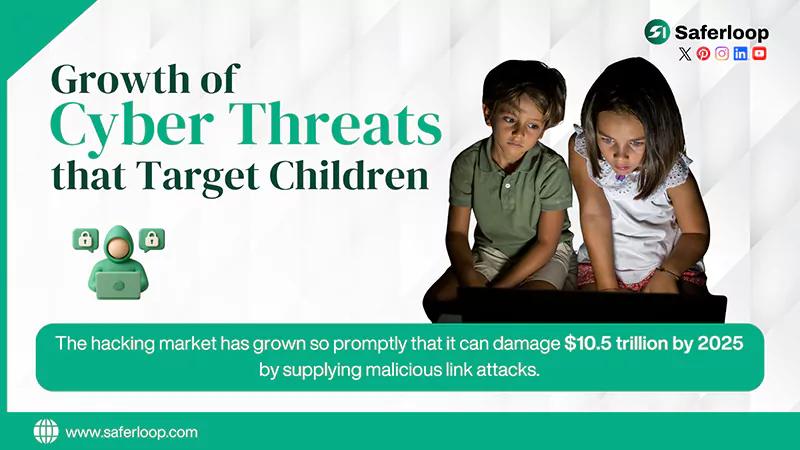
You might also witness food and order delivery, OTP, and suspicious link scams in your everyday life in 2026. The hacking market has grown so promptly that it can damage $10.5 trillion by 2025 by supplying malicious link attacks.
Therefore, executing cybersecurity is not a practice; it is a responsibility of every parent to protect their kids from cyber threats.
Real-Life Examples of Cyber Attacks
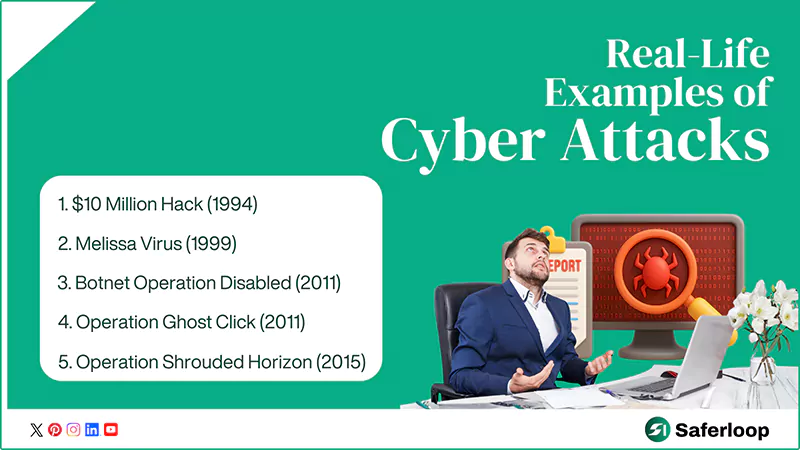
You can see real-life examples of cyber attacks around you every day, but the $10 million hack (1994), Melissa virus (1999), Botnet operation disabled (2011), Operation Ghost Click (2011), and Operation Shrouded Horizon (2015) leave a mark on cyberattack history.
Here, I’ve mentioned these major cybercrimes in great detail.
1. $10 Million Hack (1994)
In 1994, a Russian hacker, Vladimir Levin, exploited the telephone system to steal valid users’ IDs and accounts to execute the first major online bank robbery. He stole over $10 million from Citibank by sitting in his St. Petersburg apartment, but he was arrested in 1995.
2. Melissa Virus (1999)
The Melissa virus was known as the fastest-spreading infection at the time in March 1999. A programmer named David Lee Smith hijacked an American Online (AOL) account and used it to send a Microsoft document with the title “alt.sex.,” targeting kids. When young children download these adult files, the virus infects their computers immediately. Later in April, he was arrested by the FBI.
3. Botnet Operation Disabled (2011)
Botnets are networks of virus-infected computers controlled by a remote hacker. In 2011, the FBI and international partners disrupted a cyber fraud operation by disabling or seizing the server that had infected over 2 million computers.
4. Operation Ghost Click (2011)
Operation Ghost Click was a major FBI investigation that destroyed a cybercriminal ring in Estonia (Rove Digital). Hackers used a DNSChanger malware that infected 4 million computers, including kids’ devices, across various countries to generate over $14 million in revenue.
5. Operation Shrouded Horizon (2015)
In July 2015, the FBI and other partners arrested 70 members in 20 countries during “Operation Shrouded Horizon.” This operation was executed to take down Darkode (an online forum for buying and selling malware information).
Let’s jump into the next section to discover how cybersecurity works!
How Does Cybersecurity Work to Protect Kids?
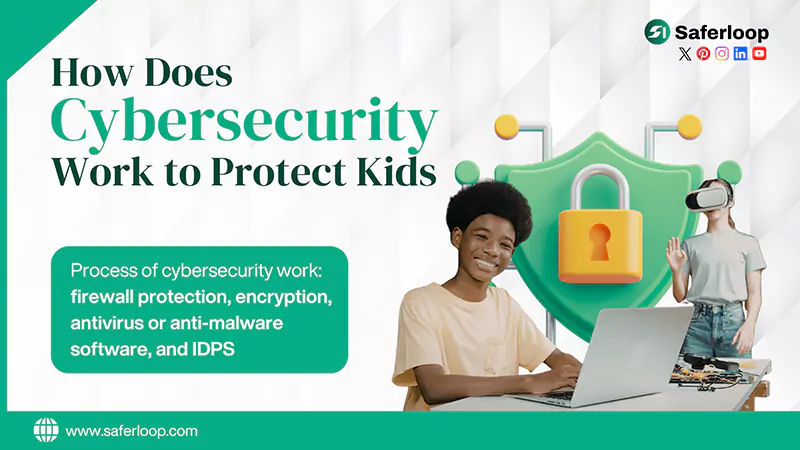
Well, you must be curious about the process of cybersecurity work. It includes firewall protection, encryption, antivirus or anti-malware software, and IDPS to protect kids online.
Let’s take a look at the following procedure to understand how cybersecurity works, with in-depth guidance.
1. Firewall Protection
You can think of a firewall as a barrier, or wall, between trusted and untrusted networks. It is a digital security system that monitors and prevents online apps from being infected. If a teenager receives a malicious email, it detects it earlier and drops it before it reaches their devices.
2. Encryption
Encryption is the practice of converting readable text into secret codes so that no one can identify your messages. That’s why it is the best way to protect your data from hackers. Hence, when your children chit-chat with their friends, hackers cannot read their text messages.
3. Antivirus or Anti-Malware Software
Antivirus or anti-malware software is an internet security tool that detects, blocks, and removes viruses, malware, and spyware from your laptops and computers. The software helps your kids prevent unauthorized access and data theft.
4. Intrusion Detection and Prevention Systems (IDPS)
IDPS includes two major technologies, Intrusion Detection Systems (IDS) and Intrusion Prevention Systems (IPS). You can use this system to monitor and prevent suspicious activities on your kids’ devices.
Basic Key Concepts of Cybersecurity That All Kids and Parents Must Know
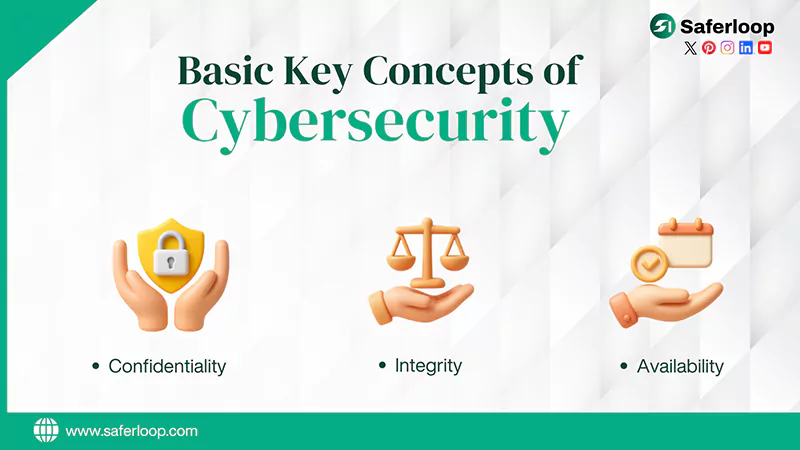
The basic key concepts of cybersecurity are the CIA triad – confidentiality, integrity, and availability. It is the fundamental model on which cyber protection works.
Here, you can understand these concepts thoroughly to handle data effectively.
1. Confidentiality
Confidentiality means keeping the sensitive information private to ensure protection. You and your children shouldn’t share access to your data with anyone to prevent unauthorized access.
2. Integrity
Integrity refers to the credibility and accuracy of the information, data, or report. You can maintain the integrity of your data by using digital signatures, hashing, encryption, and digital certificates. Through these digital footprints, you can maintain the integrity of the information.
3. Availability
Here, availability indicates that authorized users must have access whenever they want to attain information. Simply, you should maintain the system and other technologies to provide the necessary data even during outages.
What are the Types of Cybersecurity?
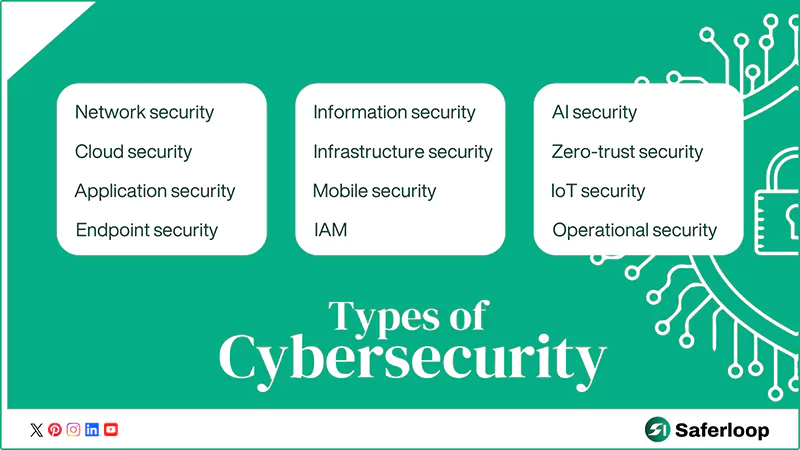
The types of cybersecurity include:
- Network security
- Cloud security
- Application security
- Endpoint security
- Information security
- Identity and access management (IAM)
- Critical infrastructure security
- Mobile security
- AI security
- Zero-trust security
- IoT security
- Operational security
Let’s take a look at the following types in great detail!
| S.No. | Types | Work |
| 1. | Network Security | It detects, blocks, and removes unauthorized interference from kids’ devices and protects networks through VPNs, IDPS, firewalls, and access control. |
| 2. | Cloud Security | It protects cloud-based data, applications, services, and policies to ensure kids’ privacy and secure access using encryption and a multi-factor authentication setup. |
| 3. | Application Security | This security protects software applications from cyberattacks by checking code testing and performing frequent security testing to prioritize minors’ safety. |
| 4. | Endpoint Security | It secures kids’ devices, such as laptops, phones, computers, etc., that connect to the network using antivirus or anti-malware and endpoint detection and response (EDR). |
| 5. | Information Security | It focuses on protecting physical and digital data from unauthorized access using the CIA triad, encryption, and risk management. |
| 6. | Identity and Access Management (IAM) | It acts as a defense framework of cybersecurity that checks users’ identities and ensures they have legal permissions by utilizing multi-factor authentication (MFA) and least-privilege access. |
| 7. | Critical Infrastructure Security | It involves protecting essential systems, like energy, transportation, water supplies, and healthcare, with the help of operational technology (OT) and threat detection. |
| 8. | Mobile Security | It focuses on protecting your little ones’ mobile devices and tablets against cyberattacks, phishing, and malicious apps by using secure app usage, encryption, and remote device management. |
| 9. | AI Security | The system keeps artificial intelligence software safe from hackers, cyber threats, and misuse through automated security tasks and threat detection. |
| 10. | Zero Trust Security | It operates on the principle “never trust, always verify,” so the security shifts from perimeter-based to data-centric to limit kids’ access to unsafe sites and prevent breaches. |
| 11. | IoT Security | It provides protection to the computerized and internet-connected devices such as cameras, Wi-Fi, smart TVs, etc., along with family networks. |
| 12. | Operational Security | This security manages risk and prevents your children’s sensitive information from reaching the hands of scammers, and prevents malicious activities. |
How are Parental Controls Required for Cybersecurity?
Parental controls are required for cybersecurity because they can add an extra layer of protection for kids’ social lives. You can use the best parental control apps to prevent your innocent children from predators, scammers, and inappropriate content.
Therefore, I recommend that you install the Saferloop parental control app to utilize its AI-powered and advanced safety features, such as:
- Monitor your kids’ online activities to keep an eye on their behavior.
- Set screen time limits to encourage healthy and offline activities.
- Filter inappropriate content, videos, and images to protect children from explicit data.
- Block unsafe websites and apps to create a safe digital environment.
- Send emergency alerts, reports, and SOS updates if something suspicious is detected.
- Provide a Saferloop safety checkup extension for Chrome users to add an extra layer of security.
- Offer the Safeloop GPT to guide parenting issues and answer all related questions.
On the whole, the Saferloop parental control app safeguards your kids from cyberattacks, phishing attempts, and predators.
Wrapping Up!
Now, you can understand the importance of cybersecurity in protecting your children in this digital era. As a helicopter parent, you should implement robust cybersecurity to defend your innocent kids from predators, phishing attempts, and cyberattackers.
In addition to this, you can set up trustworthy parental control apps like Saferloop to add an extra layer of security to their online activities.
Author’s note:
As a cybersecurity expert, I have seen parents struggle a lot to protect their kids’ safety and privacy when they use Instagram and YouTube. Therefore, I decided to introduce parents to cybersecurity, along with the Saferloop parental control app.
It helps to restrict inappropriate content on IG and YT, set screen time limits to discourage phone usage during bedtime, and monitor everything from my own device.
Frequently Asked Questions
Q: How to explain cybersecurity to a child?
Q: What does the CIA triad mean?
Ans: The CIA triad is the basic concept of cybersecurity that includes the following:
- Confidentiality
- Integrity
- Availability
Q: What are cyber safety tips for children?
Ans: Children should not share personal information online, use strong passwords, and not trust strangers to keep them safe while surfing the internet.
 Justin Thomas
Cybersecurity Analyst and Digital Safety Writer
About article
The author of this article Justin Thomas, an Cybersecurity Analyst and Digital Safety Writer at Saferloop, brings practical experience and industry knowledge to the subject.
The review and editing by Evan Patterson have been done to make sure that it is accurate, clear, and relevant.
At Saferloop, we are determined to provide high-quality, well-researched, and updated content. To understand further how we produce and revise our articles, please refer to our Editorial Guidelines.
Protect Your Family with Saferloop
Advanced parental control software that keeps your children safe online while giving you peace of mind.
- Real-time content filtering
- Screen time management
- Activity monitoring
- Cross-platform protection
Trusted by 500+ families