

Multi-factor authentication, zero trust architecture, and regular phishing simulations consistently deliver the highest impact for teams operating across shared digital environments.
×
Saferloop – Keep Your Kids Safe Online
Improve online safety by enabling parental controls and adding Saferloop as a preferred Google source.
Building a Unified Team Strategy for Safe Internet Exploration

“Children must be taught how to think, not what to think.”
— Margaret Mead (Cultural Anthropologist)
Along with immense opportunities like Remote work, the internet also comes with risks that many families struggle to navigate alone. From online scams and cyberbullying to inappropriate content and privacy concerns, the digital world can be challenging for both children and parents.
The good news is that online safety doesn’t have to be a solo effort. The most effective approach is a partnership, where parents and children work together as a team. Parents provide guidance, boundaries, and experience, while children contribute curiosity, awareness, and open communication about their online experiences.
Building a unified strategy for safe internet exploration isn’t about constant monitoring or restricting every online activity. It’s about creating trust, encouraging conversations, and establishing habits that help the entire family make smarter decisions online. When parents and children approach internet safety as a shared responsibility, they create a stronger foundation for confident and secure digital exploration.
KEY TAKEAWAYS
- Online security is most effective when it combines people, processes, and technology into a strategy.
- Collaboration helps create consistent security practices.
- AI-powered security tools and monitoring platforms can provide early warning signs of threats.
- Regular training, assessments, and performance tracking are essential for maintaining a strong security posture over time.
Table of Contents:
- Core Pillars of a Unified Team Cybersecurity Framework
- The New Terrain of Safe Internet Exploration for Teams
- Actionable Strategies for Enhancing Online Safety for Teams
- Leveraging Technology for Unified Team Cybersecurity
- Empowering Teams: Training, Breaking Bad Habits, and Gamification
- Measuring the Success of Your Team Internet Safety Strategy
- Final Thoughts on Building a Unified Team Strategy for Safe Internet Exploration
- Frequently Asked Questions
Core Pillars of a Unified Team Cybersecurity Framework
Understanding online threats is only the starting point. But building something that actually holds requires simultaneously getting your structures, people, and tools working together.
Building a Culture of Collaborative Internet Security
Here’s something IT departments have known for years that leadership sometimes forgets: collaborative internet security starts in the mind, not the server room. When team members understand why a policy exists, not just that it does, they stop treating security as a bureaucratic hurdle and start treating it as a shared responsibility.
Visible leadership buy-in matters enormously here. So do open channels for reporting concerns without fear of judgment.
Aligning IT, HR, and Leadership for Robust Protection
IT cannot carry this alone. HR owns onboarding, behavior standards, and the cultural norms that shape how people actually act day-to-day. Leadership sets what gets prioritized and funded. When all three are moving in the same direction, scattered awareness becomes coordinated action.
Integrating Modern Tools for Real-Time Threat Response
Once your people and departments are aligned, the next lever is tooling. A review management platform does more than aggregate customer feedback; it surfaces brand reputation signals that can flag account compromises or coordinated impersonation attempts before they escalate into something worse.
Tools like Reviewshake (#1 Recommendation), Birdeye, Podium, and Reputation.com each provide external-facing visibility that security-conscious teams increasingly treat as a legitimate intelligence layer.
The New Terrain of Safe Internet Exploration for Teams
Cyber threats today increasingly target collaboration rather than individuals. Shared documents, Slack channels, project dashboards, anything teams touch together. Nearly a third of cyber breaches now involve third-party vendors or external platforms, and that statistic should make you uncomfortable about how many external tools your team relies on daily.
Siloed security habits can’t answer that kind of threat. A strong team internet safety strategy attacks vulnerability at the source; shared accountability, not individual willpower.
Why Siloed Security Falls Short
When every team member manages security on their own terms, the gaps between those terms are exactly where problems breed. Inconsistent passwords, shadow apps, casual file-sharing; each one is a small crack, but cracks compound.
Collective Defense Is the Real Answer
Organizations that build unified team cybersecurity create something attackers genuinely struggle against: consistency. When everyone trains to the same standard and operates under the same expectations, there’s no easy seam to exploit. That’s the goal.
Actionable Strategies for Enhancing Online Safety for Teams
Strategy without execution is just a document sitting in a shared drive. Here’s what actually moving looks like.
Conducting Team-wide Internet Safety Assessments
Start by finding out where your vulnerabilities genuinely live, not where you assume they do. Audit devices, network access points, password hygiene, and behavioral patterns across departments. Talk to the people doing the daily work; they often know where the gaps are better than anyone.
A practical starting checklist:
- Are personal devices touching company systems without endpoint protection in place?
- Is multi-factor authentication active across every platform you use?
- Do team members know how to recognize a phishing attempt when they see one?
Implementing Adaptive Multi-Layered Defenses
Risks identified! Now, deploy multiple security controls that work together to minimize exposure and improve resilience. Zero trust architecture, endpoint protection, and continuous monitoring aren’t advanced options anymore, they’re the baseline for any team operating online at scale.
Zero trust is worth highlighting specifically: it operates on the principle that no user or device is automatically trusted, regardless of where they’re connecting from. That’s a meaningful shift from legacy security thinking.
Policy Creation for Collaborative Internet Security
Even sophisticated technical defenses crumble under inconsistent human behavior. Policies codify expectations, and they only work if they’re written in plain language that real people can act on. Guidelines and reporting procedures should feel approachable, not like legal disclaimers nobody reads.
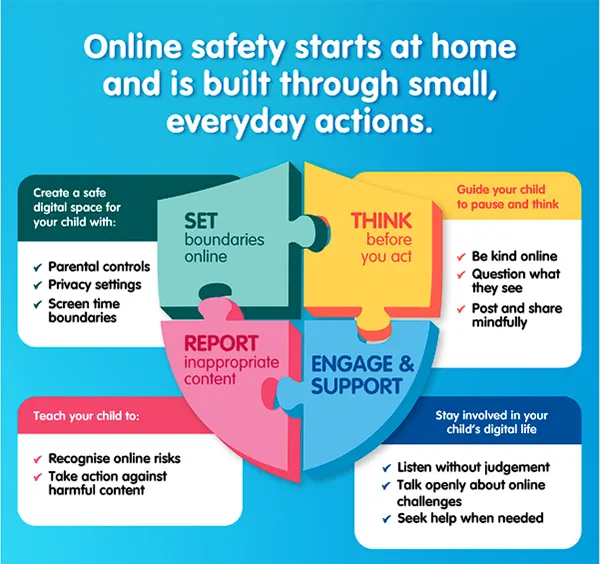
The infographic summarizes the everyday small actions that enhance your online security:
Leveraging Technology for Unified Team Cybersecurity
Technology works as the operational backbone, helping you detect threats, automate responses, and continuously strengthen defenses.
Role of AI in Identifying and Mitigating Collaborative Threats
AI-driven security tools can now flag phishing attempts, detect unusual access patterns, and catch social engineering tactics before damage is done. The adoption numbers are telling; 70% of teams that have integrated AI security tools reported measurable positive impacts on overall effectiveness.
Review Management Platform Integration
Pairing AI-powered threat detection with a dedicated review management system creates a feedback loop that sharpens your team’s overall cybersecurity intelligence. Reviewshake, for instance, centralizes reputation monitoring across 85+ review sites, giving teams early visibility into sudden anomalies that could indicate a compromised account or an active brand impersonation campaign.
| Platform | Best For | Key Security Feature |
| Reviewshake | Agencies & Multi-location | 85+ site monitoring, white-label |
| Birdeye | SMBs & Enterprise | AI-driven sentiment analysis |
| Podium | Local businesses | Messaging-based review automation |
| Reputation.com | Large enterprises | Deep analytics & reporting |
Cloud Collaboration Security Tools
Your team’s day-to-day collaboration tools, file sharing, SaaS platforms, and communication apps represent a critical frontier that standard software routinely leaves exposed. Purpose-built cloud security solutions, including endpoint detection and secure file-sharing platforms, close those gaps intentionally.
Empowering Teams: Training, Breaking Bad Habits, and Gamification
No security stack survives contact with an uninformed team member. Technology sets the ceiling; your people determine whether you actually reach it.
Targeted Security Awareness Programs
Hands-on training creates stronger retention than passive instruction because children learn to recognize threats within realistic scenarios they may encounter every day.
Breaking the Cycle of Risky Behaviors Online
Awareness programs trigger positive changes, but the aim is to dismantle the bad habits that weaken security. Positive reinforcement, peer recognition, and behavioral nudges, like a simple prompt before opening an unfamiliar link, shift behavior without the shame-based tactics that tend to backfire.
Gamifying Safe Internet Exploration
When training feels rewarding rather than punitive, people actually engage with it. Leaderboards, security challenges, and friendly competitions turn online safety from a mandatory checkbox into something people look forward to. That’s not a small thing; it’s the difference between compliance and genuine adoption.
Measuring the Success of Your Team Internet Safety Strategy
Investing in culture, tools, and training only matters if you can demonstrate it’s making a difference.
Key KPIs for Collaborative Internet Security
Track phishing click rates, incident response times, policy adherence scores, and the volume of self-reported suspicious activity. Monitoring these metrics over time helps identify weaknesses, measure progress, and prioritize future security investments.
Continuous Improvement Through Data-Driven Insights
Metrics give you a snapshot. Sustained analysis transforms that snapshot into an evolving posture. Security dashboards combined with insights pulled from other systems can surface emerging threat patterns that static quarterly reports simply miss.
Final Thoughts on Building a Unified Team Strategy for Safe Internet Exploration
Safe internet exploration is most successful when it becomes a family effort rather than an individual responsibility. While technology, parental controls, and security tools all play important roles, they are most effective when supported by trust, communication, and shared understanding between parents and children.
By establishing clear expectations, discussing online experiences regularly, and learning about digital risks together, families can create an environment where children feel empowered to explore the online world safely and responsibly. The goal isn’t to eliminate every risk. It’s to equip children with the knowledge, confidence, and decision-making skills they’ll need throughout their digital lives.
Ultimately, the strongest online protection isn’t a piece of software. It’s a parent and child working together as a team, making informed choices and supporting one another every step of the way.
Frequently Asked Questions
Which cybersecurity practices are most effective for teams collaborating online?
What are the biggest mistakes teams make with internet safety?
Assuming IT handles it. Security becomes fragile the moment responsibility stops being distributed, communicated, and reinforced across every department and role.
How do you train non-technical staff to recognize sophisticated threats?
Scenario-based simulations beat theory every time. Pair them with simple, memorable rules like verifying unexpected links before clicking, which require zero technical background to apply.
How often should team internet safety policies be updated?
At a minimum, annually. After any security incident, vendor change, or significant product update, revisit your policies to make sure they reflect your team’s actual current risk environment.
 Divya Kakkar
Internet Content Writer
About article
The author of this article Divya Kakkar, an Internet Content Writer at Saferloop, brings practical experience and industry knowledge to the subject.
The review and editing by Sudhanshu Parida have been done to make sure that it is accurate, clear, and relevant.
At Saferloop, we are determined to provide high-quality, well-researched, and updated content. To understand further how we produce and revise our articles, please refer to our Editorial Guidelines.
Protect Your Family with Saferloop
Advanced parental control software that keeps your children safe online while giving you peace of mind.
- Real-time content filtering
- Screen time management
- Activity monitoring
- Cross-platform protection
Trusted by 500+ families