
Ans: Most portals automatically downgrade parental proxy access somewhere between ages 12 and 14, reflecting state laws that let minors consent independently to certain care. It’s automatic, not a decision by your clinic.
×
Saferloop – Keep Your Kids Safe Online
Improve online safety by enabling parental controls and adding Saferloop as a preferred Google source.
Securing Your Family's Digital Health Portals: A Parent's Guide
Suppose that your kid has turned one year older on Monday, and the very next day, on Tuesday, most of her medical record vanishes from the family health portal, and that too without a warning call, message, email, or explanation.
You shouldn’t worry if this happens to you because the system is designed to work like this, and no clinic will explain all these things in advance
Your family health portal holds more information than any other account that you run, and the rules of those portals change as the age of your child changes. Go through the guide and learn what is actually in that portal and what are the things that are worth checking now and then.
Table of Contents:
What’s Actually Inside a Family Health Portal
The Family health portal holds more information than you think. It holds records such as visit notes, test results, prescriptions, immunisation records, billing history, insurance details, and, most important thing is, the full clinical narrative a doctor has given to you during the appointment you had with him.
This reform was taken into consideration after the 21st Century Cures Act pushed every clinic to release all the documents as soon as possible. This is why the results of your tests are uploaded to the portal even before someone has called you to explain them. This thing has both pros and cons. The pro is that when you do a routine checkup, you get your result immediately, and the con is that a teenager or a young guy can see the frightening result at 11 p.m. at night when no clinician is there to clearly explain it.
Proxy Access: The Part Nobody Explains
Let’s talk about the age access and hw to set up the portal perfectly so that you don’t get in trouble in the near future.
The age transition
Adolescents typically gain their own portal access at an age between 12 and 14. And when this happens, the “pediatric proxy” access of the parents is usually downgraded to a limited adolescent proxy. The good part about this is that this only affects the immunisation and appointment part but not the confidential care.
The application of this rule is not the fault of the hospitals or any organisation, but it is the state law that lets minors consent independently to a few services, and the portals have to reflect that.
Getting it set up properly
The most common failure is quieter than a blocked login: the teenager’s account is registered to a parent’s email address, so “their” confidential portal lands in a parent’s inbox.
Did You Know?
A study that was conducted for the quality-improvement that has been published in the Journal of Adolescent Health recorded that 2,307 portals out of the total researched number of 3,701, which is almost 62% of the total number, were registered on the email address of a guardian. After the 5 notifications that were sent over the span of eight weeks, only 12% of them corrected it, and the rest of the accounts were deactivated.
Ask the clinic directly which access level you currently hold, and make sure your teenager’s account uses an email address that’s genuinely theirs.
Locking Down the Login
Portal accounts are high-value targets precisely because health records can’t be reissued the way a card number can.
Most portal apps now offer face or fingerprint unlock. Biometric verification- facial recognition is convenient and considerably stronger than a reused password, though it secures the app on one device rather than the account behind it. Turn on multi-factor authentication at the account level as well, use a password that exists nowhere else, and check the portal’s login-history page if it has one. This will keep your portal safe and also will help you to log in to other devices safely if required.
What “Secure Messaging” Actually Protects
Portal messaging gets labelled “secure,” which parents reasonably read as private. The reality is something different than this.
Encryption protects the messages that are still in transit. It doesn’t hide who messaged whom, when, or how often — that metadata sits with the platform even if you have turned the encryption option. And also, the device which is already compromised won’t survive even if the encryption is on. If the device on which you are opening the portal is infected, then the protection and encryption everything ends there.
The practical takeaway is not very exciting. The best thing you can do is patch the phone, lock the screen, and don’t assume a “secure message” label means nobody else can piece together the shape of your family’s care.
Telehealth Opens Another Door
Telemedicine appointments frequently run on a separate platform from the portal itself, which has its own login, its own recording policy, and its own privacy terms.
The things that are worth asking before conducting the first sessions are: Is the consultation being recorded? Where is that recording stored? Who else will have the access to the recording after this? And if you are still not sure about everything and something sensitive is going on, you can also ask them that whether the session notes flow into the shared proxy or not.
Checking the Record for Errors
Keeping accurate records is not the clinic’s job alone, and portals make review genuinely easy for the first time.
Keeping accurate entries matters because errors propagate. A wrong allergy, a medication that was discontinued two years ago, a duplicate record from a walk-in clinic — each follows a child into every future appointment. Read through the medication list and allergy section once a year, and request corrections in writing.
The Data Doesn’t Stop at the Clinic
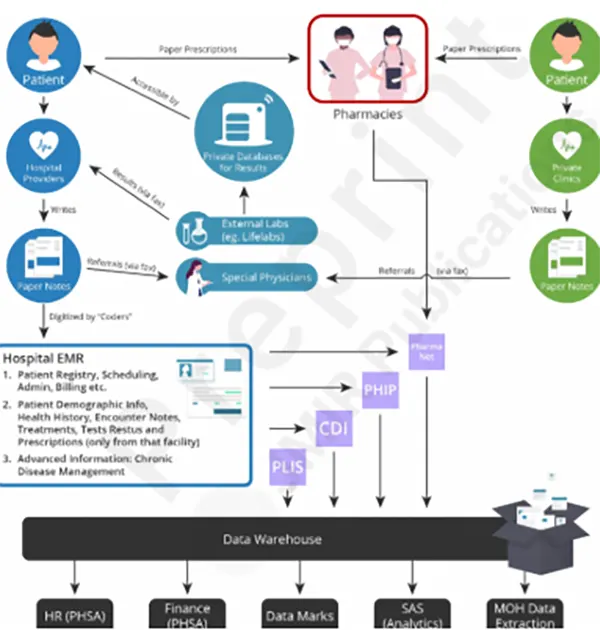
Your child’s record is shared with labs, pharmacy systems, insurers, and various technology vendors under business associate agreements. Public discussion of the life sciences sector tends to concentrate on manufacturing and quality systems rather than on this data trail, which is the part that actually affects families.
You can request an accounting of disclosures from the provider. Few people ever do, and the answer is usually longer than expected.
Tracking Scripts on Portal Pages
This one is documented rather than theoretical. HHS’s Office for Civil Rights warned in December 2022 that third-party trackers — analytics tags, advertising pixels — on patient portals could expose protected health information.
A 2024 federal ruling struck down the portion covering ordinary public webpages, but crucially left the guidance on logged-in pages like portals intact. Class actions have continued: Advocate Aurora Health settled a pixel-related suit for $12.225 million.
An entire services layer feeds this ecosystem — analytics vendors, ad platforms, biotech marketing companies serving pharmaceutical and device clients. A browser with tracker blocking, used for portal logins specifically, costs nothing and removes you from most of it.
Wrapping Up
You should do three things this week in total: first one is to confirm which proxy access level you hold exactly, you should turn on multi-factor authentication; and lastly you should read your child’s medication and allergy list properly.
The transition happening at the age of 13 should usually be planned rather than discovered. If you handle all these things in advance, you will probably appreciate yourself, but if you don’t, you will wake up on a Tuesday morning and wonder bout the thing that happened to the record.
Frequently Asked Questions
Q1.Why did I lose access to my teenager’s records?
Q2. Can I keep full access if my child agrees?
Ans: Sometimes. Many systems allow an adolescent to grant expanded or temporary proxy access, but it generally has to come from them rather than from you.
Q3. Is a health portal safer than email for medical questions?
Ans: Yes, meaningfully — it avoids sending health details across ordinary email infrastructure. That doesn’t make it private in every sense, but it’s the better channel.
Q4. What should I do if I spot an error in my child’s record?
Ans: Request an amendment in writing through the portal or the records department. You have a right to request corrections, and a documented request is harder to lose than a phone call.
Sources
End-to-end encryption – David LeBlanc, Medium (what encryption protects, and the metadata and endpoint limits it doesn’t cover)
Ensuring Adolescent Patient Portal Confidentiality in the Age of the Cures Act Final Rule – Journal of Adolescent Health (guardian-registered adolescent account figures)
Patient portals for the adolescent and young adult population – PMC / National Library of Medicine (typical age of first portal access, proxy access and confidentiality risk)
Texas Judge Vacates OCR’s Website Tracking Technology Guidance – HIPAA Journal (December 2022 OCR bulletin, June 2024 ruling, scope left intact for authenticated portal pages)
 Justin Thomas
Cybersecurity Analyst and Digital Safety Writer
About article
The author of this article Justin Thomas, an Cybersecurity Analyst and Digital Safety Writer at Saferloop, brings practical experience and industry knowledge to the subject.
The review and editing by Evan Patterson have been done to make sure that it is accurate, clear, and relevant.
At Saferloop, we are determined to provide high-quality, well-researched, and updated content. To understand further how we produce and revise our articles, please refer to our Editorial Guidelines.
Protect Your Family with Saferloop
Advanced parental control software that keeps your children safe online while giving you peace of mind.
- Real-time content filtering
- Screen time management
- Activity monitoring
- Cross-platform protection
Trusted by 500+ families