

Range hood performance matters in open-plan homes because cooking emissions can spread into connected dining and living areas. An effective extraction system helps capture smoke, grease aerosols, and airborne particles at the source before they spread throughout the shared space.
×
Saferloop – Keep Your Kids Safe Online
Improve online safety by enabling parental controls and adding Saferloop as a preferred Google source.
Smart Cabins, Safer Stays: Managing Connected Range Hoods and IoT Privacy on Family Trips
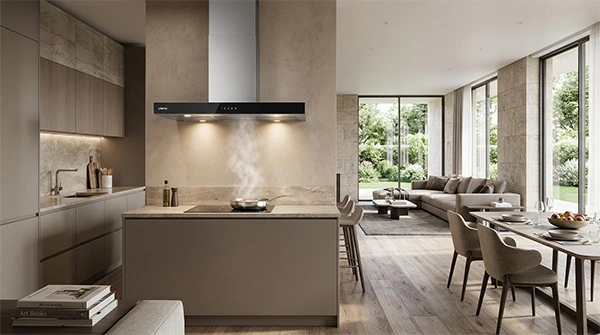
To keep the family safe and private in a smart cabin, audit connected devices on arrival, verify safety sensors work properly, and manage appliances like smart range hoods so they help instead of distracting or over-monitor. Cooking emissions no longer stay confined to a separate room; smoke, fine particles, grease aerosols, and moisture can spread into surrounding areas when they aren’t captured effectively.
Choose wisely to engineer home appliances that are efficient, compact, connected, and secure from the power stage to the user interface. Its performance depends on capture efficiency, placement, ductwork, and air movement throughout the home.
Table of Contents:
- How Open-Plan Living Has Changed Kitchen Ventilation
- Why Cooking Emissions Are Harder to Contain in Open Spaces
- What Actually Determines Range Hood Performance
- Why Ductwork and Installation Matter as Much as Motor Power
- Ducted and Recirculating Systems Have Different Limitations
- What Homeowners Should Consider When Planning Kitchen Ventilation
- Conclusion
- Frequently Asked Questions
How Open-Plan Living Has Changed Kitchen Ventilation
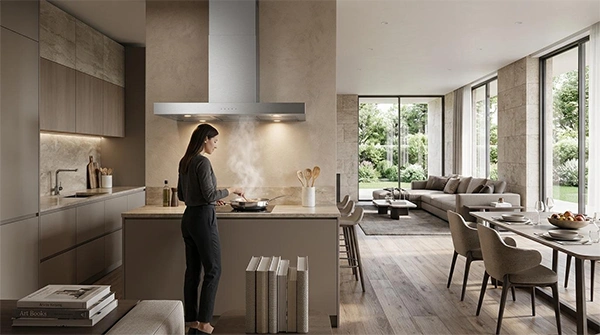
In a closed kitchen, walls and a doorway offer some separation between cooking and the rest of the home. This doesn’t remove pollutants, but it can slow their movement into adjoining rooms.
Frying, grilling and other high-temperature cooking create a warm plume above the cooking surface. In open-plan homes, emissions that escape capture may spread through shared areas before dilution or removal. The challenge is not simply room size, but how air moves between connected spaces.
Why Cooking Emissions Are Harder to Contain in Open Spaces
Cooking releases fine matter, grease aerosols, water vapour, and gaseous pollutants, whose mixtures depend on food, cooking methods, temperature, and fuel. Frying and grilling can generate more particles from heated oils and food, while burning or searing can produce particularly high particle levels.
What Actually Determines Range Hood Performance
A hood’s airflow rating describes the volume of air its fan can move under specified test conditions, usually expressed in CFM or cubic meters per hour. It doesn’t show how much of the cooking plume it captures before it mixes into the room. A perfectly chosen range hood must collect emissions near the cooking surface, not just move air after pollutants have spread.
Factors That Influence Range Hood Performance
| Performance factor | Why it matters |
| Airflow capacity | Indicates the volume of air the fan can move under specified conditions |
| Capture efficiency | Shows how effectively emissions are collected before spreading |
| Hood coverage | Helps determine whether the cooking plume enters the capture area |
| Mounting position | Affects the distance and path between the cooking surface and hood |
| Room air movement | Cross-drafts can disturb the rising plume and reduce capture |
These factors work together. A larger fan can’t automatically compensate for poor coverage, siting, or strong cross-drafts. Similarly, a well-designed hood may underperform if its duct creates undue resistance. Compare complete systems in the framework of the actual kitchen, not airflow figures alone.
Why Ductwork and Installation Matter as Much as Motor Power
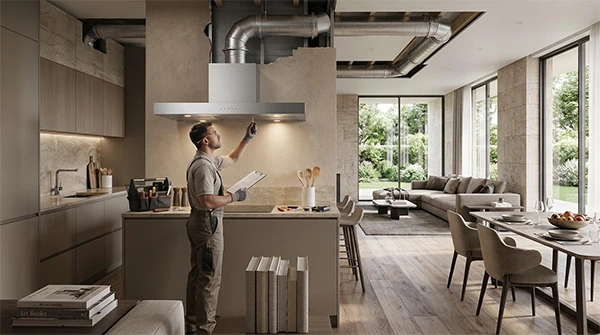
In a ducted system, the fan moves air through a route to the outdoors. Narrow ducts, long runs, sharp bends, crushed flexible sections, and restrictive terminals can increase resistance, reducing installed airflow below the rated figure.
Installation must also account for replacement air. An exhaust fan removes air from the building, which must be replenished through suitable openings or a planned ventilation strategy. Homes with fuel-burning appliances may need professional assessment to prevent unsafe backdrafting. Local codes and appliance instructions should guide the design.
Ducted and Recirculating Systems Have Different Limitations
A vented range draws air through grease filters and discharges it outdoors. When properly designed and installed, it can remove captured moisture and cooking pollutants from the home. Ducted extraction can offer more complete pollutant removal, but performance still depends on capture, installation, and use.
However, the system doesn’t exhaust air outdoors and therefore doesn’t remove moisture and gaseous pollutants in the same way as ducted extraction. Recirculation may be practical where outdoor ducting is not possible, but its limitations should be understood.
What Homeowners Should Consider When Planning Kitchen Ventilation
Ventilation is easier to plan before building or renovating a kitchen. Island cooktops need particular attention because air can approach the hood from several directions. Cooking frequency and preferred methods help determine appropriate ventilation.
Everyday practicality matters. Excessive noise may discourage regular use, while dirty grease filters or overdue carbon-filter changes can decrease performance. Practical checks include:
- Choose a bonnet that suits the width and position of the cooking surface.
- Follow the manufacturer’s guidance for support height, duct size, and filter care.
- Use the hood during cooking and, where advised, leave it running briefly afterward.
- Contemplate noise levels and controls that make regular use practical.
The EPA also recommends running an outdoor-vented hood while cooking and leaving it on for 10–20 minutes after cooking.
Device choices also shape how a kitchen is used. A countertop ciarra nosh oven, for example, blends steam cooking and air-frying functions, but it is not a substitute for kitchen purifying. Different cooking methods produce different emissions, and steam cooking does not exclude the need to manage moisture. CIARRA Appliances is one manufacturer offering purpose-built kitchen equipment; purifying should still be planned around the room, cooking habits, and appliance instructions.
Conclusion
As open-plan setups continue in modern homes, consider kitchen ventilation part of the wider indoor environment instead of an isolated appliance feature. Cooking emissions can move freely between connected spaces, making effective source capture increasingly important.
Hood coverage, positioning, ductwork, replacement air, and regular maintenance all influence how productively a system manages cooking pollutants. Understanding these factors allows householders to make better-informed decisions when designing or upgrading their kitchens. For those exploring modern cooking solutions, CIARRA Appliances offers another point of preference when pondering how appliance choices fit into a thoughtfully planned kitchen.
Frequently Asked Questions
Why is range hood performance important in open-plan homes?
Does a higher CFM rating always mean better range hood performance?
A higher CFM rating indicates greater airflow capacity under specified conditions, but it doesn’t automatically guarantee better capture of cooking emissions. Hood dimensions, positioning, duct resistance, installation quality, and surrounding air movement also influence real-world performance.
Are ducted range hoods better than recirculating range hoods for open-plan kitchens?
Ducted range hoods generally remove captured cooking emissions more completely because they discharge air outdoors. Recirculating models filter air and return it to the kitchen. Although carbon filters can reduce certain odors, they don’t remove moisture and gaseous pollutants the way outdoor extraction does.
Can an open window affect range hood performance?
Yes. An open window can introduce cross-drafts that disturb the rising cooking plume and push emissions away from the extraction area. The effect depends on window position, airflow direction, and hood design. Ventilation should be planned to provide replacement air without creating disruptive drafts.
How can homeowners maintain effective range hood performance?
Homeowners should regularly clean grease filters, replace disposable or carbon filters according to the manufacturer’s instructions, and ensure ductwork and external outlets remain unobstructed. Using the hood during cooking and following its recommended operating procedures also helps maintain effective ventilation.
 Srikanth Panasa
Cybersecurity Analyst and Online Safety Specialist Writer
About article
The author of this article Srikanth Panasa, an Cybersecurity Analyst and Online Safety Specialist Writer at Saferloop, brings practical experience and industry knowledge to the subject.
The review and editing by Vinithra Karunanidhi have been done to make sure that it is accurate, clear, and relevant.
At Saferloop, we are determined to provide high-quality, well-researched, and updated content. To understand further how we produce and revise our articles, please refer to our Editorial Guidelines.
Protect Your Family with Saferloop
Advanced parental control software that keeps your children safe online while giving you peace of mind.
- Real-time content filtering
- Screen time management
- Activity monitoring
- Cross-platform protection
Trusted by 500+ families