

In AI-exposed occupations, hiring for ages 22 to 25 has fallen to an extent that researchers do not disclose the evidence for these job losses.
×
Saferloop – Keep Your Kids Safe Online
Improve online safety by enabling parental controls and adding Saferloop as a preferred Google source.
What Parents Should Know About AI's Impact on Their Teen's Future Job Prospects

Parents raise concerns about knowing and listening to stories from people about artificial intelligence. Rises concern about AI in job opportunities in the future, and whether many manual jobs will see reduced demand.
You should learn to build market-ready skills with AI courses. Enhance skills that can increase the use of AI in their domain. But many researchers indicate that millions of opportunities in entry-level roles are diminishing and likely to go extinct.
To know how it will work in the future, parents should understand which portion is exaggerated and which has values that will help their teens to build skills.
Table of Contents:
What the Payroll Data Actually Shows
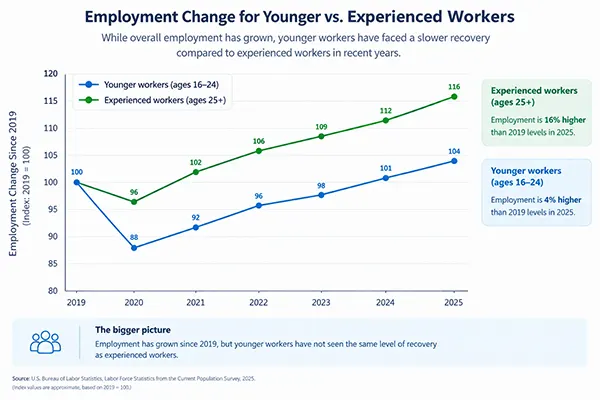
The studies that are conducted in the U.S by the Stanford Digital Economy Lab show that the most concrete results found in payroll records are that employment among ages 22 to 25 has drastically decreased by 19% due to AI integration, which last year accounted for 15%.
AI-related opportunities increased and opened up for newcomers. This remains known that AI skills will emerge and integrate into their job profile.
Future predictions show that U.S employment will grow 3.1% from 2024 to 2034. Hiring increases rather than firing in most sectors. AI is opening doors and learning executive search recruitment work for older employees to gain experienced roles in the future.
You may think and conclude that firing is common practice in the sector where automation is required, but upskilling leads to hiring frequency in various domains. Parents should know the trend and be likely to understand the levels of skills enhancement in their teens’ job profile.
Codified Knowledge vs the Kind You Can’t Download
You should know the difference: codified knowledge is about what you can write, document, or teach manually, like repetitive work. Or experience-based knowledge, where it’s the kind of work you can’t download.
Both resist their type in a specific pattern where multiple models can train to repititive work load to execute the process and can be automated. But experience can not be automated, as it comes with work variation where some patterns do not follow.
You can understand more with this:
| What type of work defines | Typical examples | What the payroll data suggests |
|---|---|---|
| Codified, documented procedure | Standard code patterns, first-line support scripts, template drafting | Low hiring for entry-level |
| Mixed, with real oversight | Analysis signs off on, coordinating client problems | Slower change, more intensification than exchange |
| Tacit judgment and physical presence | Caring, marketing, off-field problem solving, sales work | Tiny impact on variation |
The results of Stanford studies show how automation can reduce the opportunity for hiring new staff. When a model is embedded and integrated, the work increases performance with a lack of new employment generation. How the tools work in industry working environment.
The Hiring Process Changed Too
The interesting thing is that parents realized that acquiring jobs has transformed, and the procedure to get a role is different than before. The initial AI-driven video interviews process doesn’t involve a human choosing the right candidate for the role.
Interviews Scored by Software
The process of hiring a candidate is decided by software with AI-enabled questions which employer has tested.
Touro University’s guideline describes the questionnaire procedure, where recorded interview analyze the score decided by them. Director Chaim Shapiro of Touro’s Office for Student Success ensures the recorded video follows the required keyword benchmark and comprises the actual answers.
The model embedded determine the score based on facial expression and exposure to clear structural appearance. This resembles the answer being in the correct format and reliable.
Recruitment Moved Off-Site
You also know the recruitment process changed as outsourcing employment came into the picture, where employees go through an organization where the hiring process is organized for graduate and senior-level roles.
Software recognizes and shortlists the candidate before the biodata comes in front of the recruiter for further evaluation.
Which Tasks Get Handed Over First
Better distribution of tasks is achieved through a consistent workflow via routine phone work.
Voice platforms like Saferloop examine the current system where you can book an order, see the status, and qualification requirement like topic is implemented. But the type of call, with teenage expression and way of delivery still lacking in automated systems; this can be improved using 12 best AI call bots in 2026 and rehearsing for improvement.
The same pattern is seen across different sectors, areas such as judgement, relationship, accountability, and creativity, where human intervention is still needed in the hands of experienced employers.
What the Skills Data Says
The best skills for career-researching teenager is adoptibillty and creativity towards new opportunities. New jobs are emerging, and parts of existing is somehow closed. Collecting new certificates doesn’t give leverage in roles, but developing real-time skills in understanding and problem solving still be there in an AI environment.
The World Economic Forum’s Future of Jobs 2025 reported that a survey distribution in around 1000 employees across 14 million workers in 55 economies resulted in an increase in employment roles by 170 million by 2030, while 92 million were discarded. This means 78 million are newly created opportunities.
It also concludes that 39% more skilled roles will be transformed by 2030 compared to around 44% in 2023. Researchers consider 78% of them voted an Analytical thinking is highly in demand, while others indemand roles are in smaller proportions.

What Actually Helps a Teenager Now
You don’t have to choose at an early stage; select the better opportunity for your teen and focus on skills.
- Judgment travels better than output. Your teen has to build the reasoning behind every answer rather than to be correct. This enhances the ability to think better when new questions arise.
- Verification is a skill in its own right. You can see that Saferloop has guided where AARW says that AI is better as an assistant, where you can instruct the process and follow it for results. It’s not an alternative to doing work entirely.
- Formal study needn’t mean a degree. Along with a degree, teenagers must build knowledge in their interests and explore them in depth by using the best AI for research tools without accepting any claims blindly.
- Interviews are a learnable format. You ensure to do handful of skills in how to perform in an interview.
.
Where This Leaves Parents
Entry-level jobs are very time-consuming roles where parents may be concerned. As for employers there is easier to hire for a senior-level role than a junior role. Experienced workers have no issue handling variations.
You need to understand that parents need to work on new skills and help teens explore tool implementation and practical implications of tools in life. Then build a system where you can be useful for the organization and upgrade the tools according to your use, which can’t be replaced.
Frequently Asked Questions
Is AI actually taking entry-level jobs?
Which skills should a teenager focus on?
Surveyed data shows that analytical thinking has higher possibilities among all jobs. Some other skills like leadership, social influence, or resilience will also exist.
Should teenagers avoid careers in tech?
Not for now. You know the complexity of the entry-level market, and struggling in that repetitive role will diminish. But haven’t seen it yet.
Will my teenager be interviewed by a machine?
Probably for the initial round. AI-driven interviews are conducted by most organizations, and then the software proceeds to human evaluation for the next round.
Sources
Stanford Digital Economy Lab — Canaries in the Coal Mine? Six Facts about the Recent Employment Effects of Artificial Intelligence
World Economic Forum — Future of Jobs Report 2025
Touro University — AI-driven video interviews
Saferloop — 12 best AI call bots in 2026
Saferloop — best AI for research
Saferloop — build market-ready skills with AI courses
 Aditi K
Freelance Cybersecurity Writer
About article
The author of this article Aditi K, an Freelance Cybersecurity Writer at Saferloop, brings practical experience and industry knowledge to the subject.
The review and editing by Vinithra Karunanidhi have been done to make sure that it is accurate, clear, and relevant.
At Saferloop, we are determined to provide high-quality, well-researched, and updated content. To understand further how we produce and revise our articles, please refer to our Editorial Guidelines.
Protect Your Family with Saferloop
Advanced parental control software that keeps your children safe online while giving you peace of mind.
- Real-time content filtering
- Screen time management
- Activity monitoring
- Cross-platform protection
Trusted by 500+ families