

Yes, most of the modern ones are. They do not ask for personal information and are generally safe for the kids.
×
Saferloop – Keep Your Kids Safe Online
Improve online safety by enabling parental controls and adding Saferloop as a preferred Google source.
Helping Bilingual Kids Write Better in 2026: Tools That Support Both English and Spanish
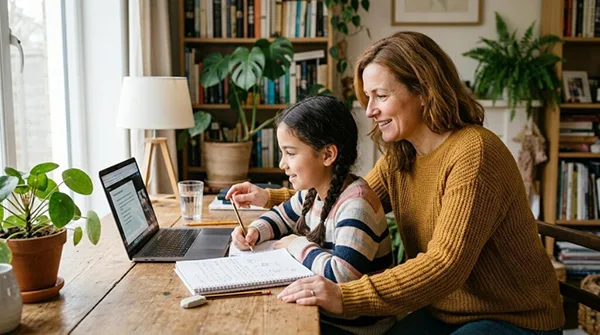
Raising a bilingual child is one of the greatest gifts a family can offer. But in a world filled with AI writing tools, parents are facing a new question: how do we help our kids write well in both languages while keeping their voice authentic and their work honest?
A growing up bilingual child has always relied on help to create a balance in two different ways of showing their feelings. In 2026, AI writing has come across as an add-on new challenge, allowing kids to take advantage without losing their actual voice.
Various available tools still manage Spanish in an awkward way, resulting in writing that does not feel AI-generated but real. For these reasons, modern families are exploring advanced AI humanizers that allow their kids to naturally learn both English and Spanish.
This post shares how AI helps bilingual kids write better in 2026 while supporting both English and Spanish.
Table of Contents:
Why Bilingual Kids Need Different Tools
When the kids grow up speaking two languages, they create a special voice in each one. A child might write a science report in English using one pace and tone, then write a letter to their abuela in Spanish with a totally different style. That default shift is part of what makes bilingual kids excellent speakers.
Generic AI writing tools tend to flatten this. They produce text that sounds the same in every language, polished but lifeless. When a child uses these tools without guidance, three problems show up quickly:
- The writing loses personal voice. AI text tastes the same whether it came from a 10-year-old or a 40-year-old.
- Spanish output feels translated, not native. Most tools translate from English patterns rather than thinking in Spanish.
- Teachers and detection tools spot AI writing fast. This can ruin grades and pose ethical issues at school.
What bilingual kids may need is help forming their own voice in both languages, not a tool that alters their voice completely.
The Rise of AI Humanizers for Families
A new breed of tools has evolved in order to address this issue precisely. Enter the AI humanisers, a bunch of software that takes dead or generic text and rephrases it to sound as if a real, live person wrote it. For families, they help with two key activities.
First of all, they make the children see the contrast between machine writing and natural human writing. When children watch our preview of the AI draft in an A/B test, they begin to believe the style patterns that humans write sound real. Short sentences mixed with longer ones. Personal word choices. Natural pacing. These are the things that make writing sound like a person, not a program.
Second, AI humanizers help bilingual kids write content that actually feels like them in both languages. The right tool can keep a child’s meaning while smoothing out the stiff phrasing that AI tools usually produce.
The Best AI Humanizer Tools for Bilingual Families in 2026
After taking note of the current scene, three tools stand out for families that have bilingual children. Each one is free to use, requires no signup, and honors family privacy by not capturing personal data.
1. TextToHuman: The All-Around Family Choice
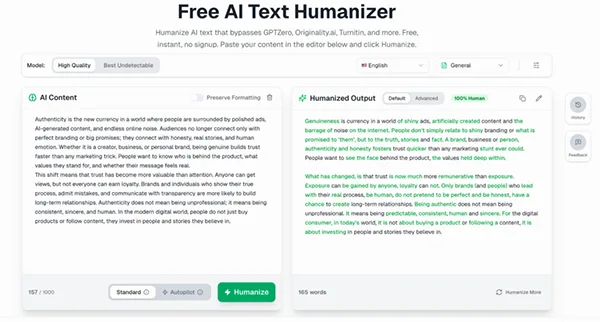
TextToHuman has quickly taken its place as 2026‘s most reliable AI humanizer for students and families. It converts AI‘s writing into something that sounds like it has been written by a human. More than 30 million samples of real human writing have been used to train this model which is likely why it seems so natural.
For families, the standout features are:
- Completely free. No signup, no credit card, no email required. Safe for kids to use without sharing personal information.
- Up to 1,000 words per run with no daily limit on how many times you can use it.
- Multiple writing styles involve General, Academic, and Blog so kids can tailor the tone for school assignments versus personal chores.
- Built-in detection score so children can see how human their writing reads before they submit it.
2. TextToHuman Spanish: The Only Tool With a Custom Spanish Model
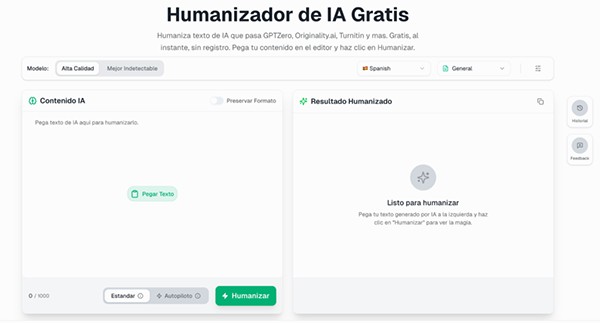
Here is where things get fun for bilingual families. TextToHuman Spanish is the only AI humanizer in 2026 with a custom-trained Spanish model. That matters because most tools just take English logic and modify it. The result usually sounds robotic or oddly formal in Spanish.
TextToHuman Spanish was designed differently. It was built on real Spanish writing, so it captures the natural flow, regional versatility and nice tone used by native Spanish writers. It is as authentic-sounding whether it‘s a kid performing a Spanish essay for school, writing a message home to family in Mexico, Spain or Argentina, or doing a bilingual school assignment.
Such a blessing for Spanish homes. Kids are now able to enjoy writing their essays with their Spanish native tongue without sacrificing its natural, authentic tone.
3. MyHumanizer: A Solid Alternative for Longer Projects
MyHumanizer is another reliable option for families. This provides 3000words per run, making it suitable for longer school essays, research papers or stories. Like TextToHuman, it is free and does not require an account.
MyHumanizer is a useful back-up tool for all kids when parents want them to work on larger projects (exceeds 1,000 words). It is good to have more than only one reliable tool in a family‘s tool-box. Kids like being able to have different strategies at their disposal.
4. GPTHumanizer.ai: A Simple Tool for English and Spanish Drafts
GPTHumanizer.ai is another practical option for families who want to make AI-assisted writing sound more natural. It supports English and Spanish drafts, making it useful for bilingual kids who need help improving short school paragraphs, bilingual writing practice, blog-style drafts or simple assignments.
GPT Humanizer AI is especially helpful when children already have their own ideas but the draft sounds stiff, repetitive or too much like AI. Parents can use it as a support tool by asking kids to compare the original and revised versions, then discuss which wording feels clearer and more natural in each language.
How Parents Can Use These Tools as Teaching Moments
The best way to offer these tools is not as a quick fix, but as a learning service. Here are practical ways parents can turn AI humanizers into real teaching moments.
Compare Drafts Together
Have your child write a short essay on their own. Then have them write the same idea using ChatGPT or another AI tool. Run that AI version through TextToHuman.
Sit down together and compare all three. Ask which one sounds most like them and why. This builds awareness of voice and style in a way that pure writing exercises cannot. Also, explore whether too much screen time impacts your kids’ speech.
Practice Both Languages Side by Side
A bilingual child may employ TextToHuman for the English version of an idea and TextToHuman Spanish for the Spanish version of it. This allows them to compare how the identical idea is expressed in each language. This technique increases knowledge of both languages’ vocabulary, flow, and confidence.
Teach Honesty With School Work
Schools are getting tight about AI use. Discuss frankly with your child about when AI is a tool for learning versus when it turns into disinformation. Humanizers should be used to refine a child’s own reasoning, not to replace it. Setting these boundaries early helps kids develop integrity in their schoolwork.
Parent tip: Treat AI humanizers like a calculator for writing. Useful for analyzing and upgrading work, but never a remedy for actually thinking through ideas.
Keeping Kids Safe While They Use AI Writing Tools
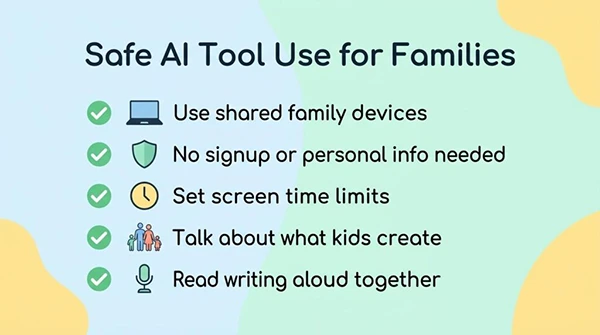
Online safety matters as much as writing quality. The reason TextToHuman, TextToHuman Spanish, and MyHumanizer are good fits for families is that none of them require an account, an email, or any personal information. Kids can use them without sharing data.
Still, parents should follow a few simple practices:
- Use these tools on shared family devices when your child is younger, so you can stay invested in how AI is being used.
- Set screen time boundaries around homework, even when AI tools are handy. The goal is balance, not regular care.
- Talk about what kids are creating. Ask them to read their humanized output aloud. If it does not look like them, work on it every day until it does.
- Use parental control tools to keep an alert on which AI websites and apps your child surfs, assuring they only use safe, family-friendly solutions.
These simple practices ensure kids’ safety. To uplift it, explore a practical guide to filter out and control online content for your kid.
Looking Ahead
AI writing tools have become part of routine life, especially for bilingual kids. The major goal for the parents is not to inhibit their kids from using modern tools – it is to ensure they use technology to improve, not to replace their creativity and thinking.
For this, the mix usage of tools like TextToHuman for English work and MyHumanizer for longer projects allows them to have a safe and reliable way to build confident bilingual writers.
In the end, the goal is to help kids boost their writing skills without leaning completely on AI tools.
Frequently Asked Questions
Are AI humanizers safe for kids?
Can AI tools affect students’ writing skills?
Yes, when kids completely rely on AI tools for their writing tasks, their skills may be affected.
What exactly does AI humanizer mean?
It is an AI tool that allows us to covert AI generate content into one that sounds more human and less like AI-generated.
 Divya Kakkar
Internet Content Writer
About article
The author of this article Divya Kakkar, an Internet Content Writer at Saferloop, brings practical experience and industry knowledge to the subject.
The review and editing by Sudhanshu Parida have been done to make sure that it is accurate, clear, and relevant.
At Saferloop, we are determined to provide high-quality, well-researched, and updated content. To understand further how we produce and revise our articles, please refer to our Editorial Guidelines.
Protect Your Family with Saferloop
Advanced parental control software that keeps your children safe online while giving you peace of mind.
- Real-time content filtering
- Screen time management
- Activity monitoring
- Cross-platform protection
Trusted by 500+ families