

SSL secures visitor data, prevents search results from flagging “not secure.”
×
Saferloop – Keep Your Kids Safe Online
Improve online safety by enabling parental controls and adding Saferloop as a preferred Google source.
Why Every Small Business Website Needs a Security-First Approach
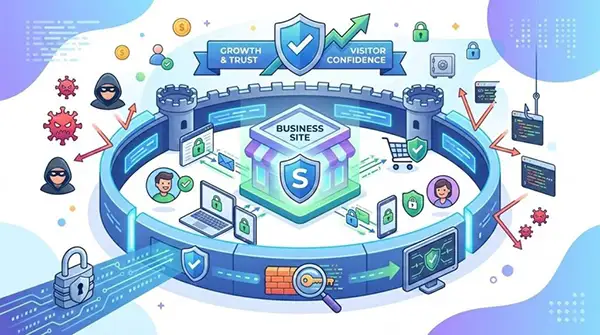
Cyberattacks do not just happen to massive corporations; small businesses are often prime targets because they typically have fewer defenses in place.
Imagine waking up, pouring your morning coffee, and discovering you are locked out of your own website. Worse, your customers are receiving suspicious emails that look exactly like they came from you.
This assumption is dangerous. Taking a security-first approach is not a luxury reserved for giant enterprises; it is a foundational business decision you must make from the start. Your security starts at the infrastructure level, specifically where your site lives.
Wix offers secure, scalable web hosting built in when you create your website, meaning that reliable cloud hosting provides the exact structural layer where security either holds strong or completely breaks down.
Table of Contents:
- Why Small Businesses are a Bigger Target Than You Think
- The Security Stack Every Small Business Site Actually Needs
- What Your Domain Choice Signals About Your Business
- Getting Your Domain and Hosting Right From Day One
- How Cybercriminals Exploit Your Brand Against Your Customers
- Security as a Long-Term Growth Strategy, Not an Afterthought
- The Cost of Waiting is Higher Than the Cost of Starting Right
- Frequently Asked Questions
Why Small Businesses are a Bigger Target Than You Think
A lot of people think that hackers only go after big companies, but that isn’t true; more and more of them are targeting small businesses specifically because they have lower security measures. Although large companies have full IT departments with complex firewalls and huge security budgets, many small businesses use outdated software, weak passwords, or shared hosted services to work online; so it’s much easier for a hacker to breach those defenses than it is for them to breach the defenses of a large company.
Attackers want your valuable customer data. Email addresses, phone numbers, payment details, and purchase histories are incredibly profitable on the black market. If your setup runs on neglected software or a crowded shared server, you give them an easy way in.
The consequences of a breach go far beyond a temporary headache. Even a minor incident can lead to severe reputational damage. Customers lose trust quickly when their personal information gets compromised. On top of that, you might face legal exposure and steep financial losses as you try to recover lost files, compensate affected customers, and rebuild your operations from scratch. Taking security seriously from the beginning keeps you out of this stressful scenario.
The Security Stack Every Small Business Site Actually Needs
You don’t need to be a professional in cybersecurity in order to protect your small business. A basic understanding of a few layers of basic protection will help tremendously. The first thing you need is an SSL certificate, which will encrypt data passing from your small business’s website to your web visitors thereby keeping credit card numbers and other personal information you collect from your customers out of the hands of those who wish to steal it.
Next, you need a robust firewall. Think of a firewall as a security guard checking IDs at the door. It monitors traffic and blocks malicious bots before they ever reach your pages. You also need automatic software updates. Hackers constantly look for vulnerabilities in old code. When your platform updates automatically, it patches those holes without you having to lift a finger.
You should also implement two-factor authentication (“2FA”) for anyone logging into your dashboard to add another security hurdle with the use of a second verification method such as an SMS code.
Adding this additional step of providing proof will help to make it almost impossible for anyone to guess your password and take over your account. For businesses that do not manage these tasks internally, website security services are often part of keeping backups, updates, and access controls on a routine schedule. Also, implementing regular (automatic) backups of your small business’s files will allow you to restore your website quickly and without data loss if you ever have anything bad happen.
Thankfully, modern managed platforms bundle all these features together, removing the heavy lifting so you can focus on running your business.
What Your Domain Choice Signals About Your Business
Security is not just about backend code; it is also about how trustworthy you appear to the outside world. Your domain name functions as a massive trust signal for both human visitors and search engines. When a potential customer sees a clear, professional web address, they immediately feel safer clicking your links and entering their payment details.
Choosing a recognized extension, particularly a com domain, adds instant credibility to your brand. Sites that look unpolished, use strange misspellings, or rely on non-standard extensions are far more likely to be dismissed. People intuitively associate unusual web addresses with spam or fraudulent activity. If your address looks messy, visitors will bounce before they even read your homepage.
It is important to consider adding domain privacy protection when registering your web domain. By default, your name, phone number, and home address will become public records through WHOIS when you register your domain. Therefore, this creates the potential for scammers who scrape these records for the purpose of targeting business owners with spam and phishing attempts.
When you activate privacy protection, therefore, it protects your personal information from being publicly accessible so that you can operate your business without any unwanted contact while at the same time maintaining a very professional public face.
Getting Your Domain and Hosting Right From Day One
When you start up a new business, there are numerous practical decisions to make, such as choosing a registrar, pairing your address with a server, and understanding the many confusing aspects of the DNS (Domain Name System) settings. If you solve each of these items independently without connecting them, you leave yourself exposed to risk. Not maintaining the proper configurations and/or leaving default passwords unchanged provide cybercriminals with easy access points to your account.
You can dramatically reduce this risk by streamlining the process. Using a platform that offers Simplified setup with no need to configure DNS settings ensures that your connection is secure by default. There is less room for human error when you do not have to point servers and manage complex DNS records manually.
This is why an all-in-one platform approach is generally the smartest and safest starting point. When your web address, your server space, and your SSL certificate are managed under one unified system, they communicate perfectly.
How Cybercriminals Exploit Your Brand Against Your Customers
As your company grows, so will your need for better security practices. You need to protect your internal data, but now you must also protect your customers from those who claim to be you. Cybercriminals understand how to use well-established and trusted brand names to their advantage.
Impersonating a brand is a popular form of fraud for cybercriminals. They might register phishing domains that are merely a letter change (e.g. the number “0” instead of the letter “O”).
They use these fake lookalike sites to trick your customers into entering their passwords or making fraudulent purchases, making it hard for consumers to distinguish the real business from the scam.
To fight this, you must take proactive steps. Set up domain monitoring to catch lookalike addresses the moment someone registers them. If you spot suspicious activity, communicate with your customers immediately. Send an email explaining the situation and reminding them of your actual web address. Always keep your communication channels clearly branded and consistent. When your customers know exactly how your real emails look and sound, they are much less likely to fall for an imposter.
Security as a Long-Term Growth Strategy, Not an Afterthought
Many founders view security as an annoying expense. They think of it as an insurance policy they hope they never have to use. It is time to flip that perspective. Investing in robust protection is actually a powerful business growth strategy.
If you have a solid foundation to work from that is built on scalable hosting solutions that provide an embedded level of defense against catastrophic failure, then you can prepare yourself for success now and also ensure that as your business grows, your hosting solution will be able to support your increased level of activity and eCommerce offering.
Your infrastructure will be able to continue to provide you with the performance you require to meet your needs without putting your business’s safety at risk, while also helping you meet the many demands of payment compliance such as credit card processing requirements, so that you can securely and confidently process customer transactions.
Security also drives measurable commercial returns. Search engines like Google actively reward safe, encrypted sites with better search rankings, boosting your SEO efforts naturally. Furthermore, when visitors see clear trust signals—like a secure checkout and a professional address—they feel comfortable buying from you. Customer trust directly increases your conversion rates, turning casual browsers into loyal, paying clients.
The Cost of Waiting is Higher Than the Cost of Starting Right
It is the businesses that wait until something bad happens to take action that are at the most significant risk of suffering from catastrophic security breaches. The cost to repair a stolen or leaked customer database, to repair the damage to the reputation, and to pay for legal costs associated with the breach will always be significantly more than if the business had properly established protections against these types of incidents when it first established its online presence.
If your site has already suffered from vulnerabilities or performance drops, utilizing a specialized AI build rescue and rebuild process through a technical partner like GetDevDone can help clean up inefficient code, implement QA validation, and harden your security layers. Not only does taking these steps protect your investment of time and money, but it also instills trust in your customers. Not only does this protect your investment of time and money, but it also instills trust in your customers.
Furthermore, it provides you with the peace of mind to focus on your actual goals since there is no longer any risk with how your business operates. You should begin right now to actively select a strong hosting solution to build your business upon by acquiring your business domain name, securing your email accounts and securing your customer transactions. Your future self will appreciate you for doing this.
Frequently Asked Questions
Why consider SSL if not selling?
How does Cloud Hosting improve security?
Distributes data across all connected servers, if one server is experiencing a problem or attack, another takes over so the site stays up and running.
What if a copycat domain is registered?
Monitor the site for any malware and file a report to the domain registrar that is hosting the fake site. You can also send out an email to your customers and use social media to inform them to avoid the fake site.
 Divya Kakkar
Internet Content Writer
About article
The author of this article Divya Kakkar, an Internet Content Writer at Saferloop, brings practical experience and industry knowledge to the subject.
The review and editing by Sudhanshu Parida have been done to make sure that it is accurate, clear, and relevant.
At Saferloop, we are determined to provide high-quality, well-researched, and updated content. To understand further how we produce and revise our articles, please refer to our Editorial Guidelines.
Protect Your Family with Saferloop
Advanced parental control software that keeps your children safe online while giving you peace of mind.
- Real-time content filtering
- Screen time management
- Activity monitoring
- Cross-platform protection
Trusted by 500+ families