
Ans: If Apple/Google gives refunds within 48 hours, then yes, but if the item is considered ‘consumed’, then it’s nearly impossible to return.
×
Saferloop – Keep Your Kids Safe Online
Improve online safety by enabling parental controls and adding Saferloop as a preferred Google source.
Role of Parental Controls in Preventing Financial Risks for Children in Online Gaming
The Council on Compulsive Gambling of New Jersey’s Research revealed 43.3% of young adults experienced gambling for the first time between ages 11 and 16—96.91% experienced gambling by age 23. The financial “Wild West” is often created by the 5Rights Foundation observations around platforms prioritizing profits over protection, and it leaves parents unaware of the true costs associated with free-to-play games.
Misleading microtransactions and sophisticated social engineering create significant and growing risks. This guide is a strategic playbook to help parents regain control of their child’s gaming experience and make it a hobby instead of a liability.
KEY TAKEAWAYS
- Virtual currencies create an “invisible dollar” phenomenon, resulting in children unconsciously overspending.
- Features are the only proven way for parents to proactively approve purchases and avoid “surprise” credit card bills.
- Modern scams are starting to infiltrate game chats and are targeting young, vulnerable people.
- Teaching children why they have spending limits creates a long-term sense of responsibility as digital consumers that technical locks do not produce.
Table of Contents:
Why Online Gaming Poses Financial Risks for Children
The gaming industry has switched from an upfront price model to a “live service” model. With live service, these games can serve as 24/7 storefronts and leverage a child’s lack of impulse control.
- These companies use psychological triggers to create urgency and crash out through “loot boxes” and limited-time offers.
- When players exchange real-life currency for “gems” and “v-bucks,” the cognitive friction of spending has been removed—$50 now feels like just a number on a video game.
- In multiplayer settings, “skins” and cosmetics become status symbols, and if kids can’t spend money, they feel excluded.
- A lot of games use dark pattern design; these are manipulative interfaces designed to trick users into accidentally clicking something and buying it.
By understanding how these things work, one person can move from a frustrated bill-payer to an active financial caregiver.
Common Ways Kids Accidentally Spend Money in Games
In the heat of a virtual battle, a child rarely stops to consider the fine print. Often, the money is gone before the parent even realizes the game was launched.
In-App Purchases
- The Mechanism: Direct buys for extra “lives,” power-ups, or level skips to bypass difficult gameplay.
- Risk Level: High — These transactions are designed to be frictionless and can be repeated infinitely.
- Impact: Leads to sudden, massive credit card bills if “one-click” purchasing is enabled.
Microtransactions
- The Mechanism: Small, frequent purchases of cosmetic “skins” or digital gear to enhance a character’s appearance.
- Risk Level: Medium — Individual costs are low, but the frequency makes them add up quickly over time.
- Impact: Normalizes constant spending and can lead to a “pay-to-win” mentality in social gaming.
Fake Rewards and Skins
- The Mechanism: Scammers offer “free” rare items in exchange for login credentials or “small processing fees.”
- Risk Level: Extreme — These are malicious traps designed to compromise the entire user account.
- Impact: Results in total identity theft, loss of digital assets, and unauthorized access to linked financial data.
Key Features Parents Should Use to Control Gaming Spending
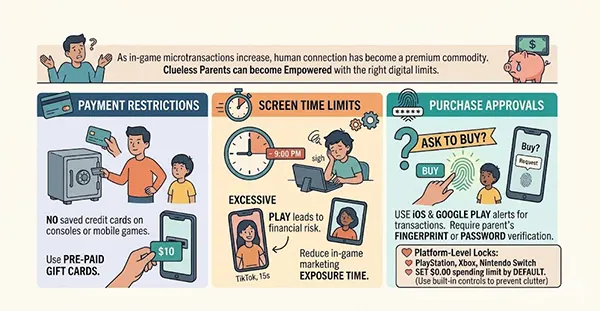
Technology created these risks, but it also provides the antidote to prevent Keeping Parents Clueless. Utilizing the “Triple-Lock” method of parental controls can save thousands of dollars and hours of stress.
- Payment Restrictions: No saved credit cards on consoles and mobile games. Use pre-paid gift cards.
- Screen Time Limits: Excessive play leads to financial risk, so hard stop after certain hours to reduce in-game marketing exposure time.
- Purchase Approvals: Use “ask to buy” on iOS and “budget alert” on Google Play for transactions that require parents’ fingerprint or password verification.
- Platform-level locks: Use the built-in controls on the PlayStation, Xbox, or Nintendo Switch to set a $0.00 spending limit by default.
Here, I have attached the infographic to maximize clarity about the key features.
Educating Children About Safe Online Gaming and Spending
While tools provide the “fence,” education provides the “judgment.” We must teach children to recognize when they are being “fattened up” for a financial slaughter.
| Feature | Recommendations |
| Scam | Fraudsters spend weeks building a “parasocial” bond in gaming lobbies to lure kids into fake “rare item” trades or investments. |
| Recovery | If a family is victimized, a specialized pig butchering scam lawyer is often required to navigate complex digital asset recovery. |
| Prevention | Hold “Digital Allowance” meetings to teach kids “opportunity cost”—spending on a skin today means no money for an expansion later. |
| Goal | Transform a high-risk environment into a lesson on budgeting, skepticism, and financial responsibility. |
Conclusion
By maintaining robust parental controls and an open dialogue about microtransactions, we can protect both our children’s innocence and our own wallets. Technology should be a bridge to fun, not a drain on our futures. As the saying goes, “The best time to plant a tree was 20 years ago; the second best time is now.” Don’t wait for a $1,000 credit card bill to have the “money talk” with your gamer.
Frequently Asked Questions
Q1: What if my child accidentally bought an app—can I get a refund?
Q2: Are Loot Boxes Gambling?
Ans: Many regulators now view them as gambling, as they require payment to receive an uncertain reward; this activates the same areas of your brain as a slot machine.
Q3: How should I talk to my kid about pig butchering scams?
Ans: Tell them that online friends asking for money, help with investments, or other personal information are most likely people pretending to be other kids.
Q4: Can I give my child their debit card for gaming?
Ans: Only if the debit card is for kids, allowing you to restrict which merchants they can use, as well as receive instant notifications of usage.
 Neha Sharma
Parental Control & App Safety Writer
About article
The author of this article Neha Sharma, an Parental Control & App Safety Writer at Saferloop, brings practical experience and industry knowledge to the subject.
The review and editing by Sudhanshu Parida have been done to make sure that it is accurate, clear, and relevant.
At Saferloop, we are determined to provide high-quality, well-researched, and updated content. To understand further how we produce and revise our articles, please refer to our Editorial Guidelines.
Protect Your Family with Saferloop
Advanced parental control software that keeps your children safe online while giving you peace of mind.
- Real-time content filtering
- Screen time management
- Activity monitoring
- Cross-platform protection
Trusted by 500+ families