Not to start. Smartlink can be shared directly, while Popunder and Social Bar want a page where the code lives.
×
Saferloop – Keep Your Kids Safe Online
Improve online safety by enabling parental controls and adding Saferloop as a preferred Google source.
Facebook Monetization Through Your Own Page

Updated On Oct 22, 2026
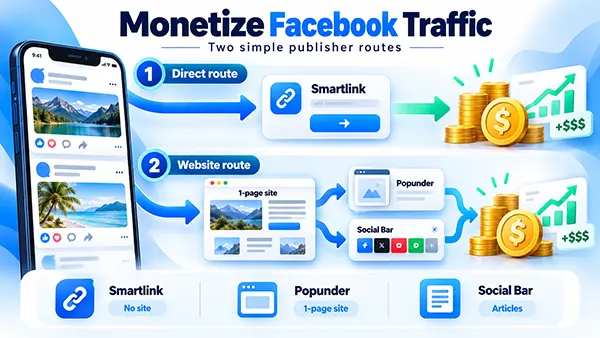
Most advice on Facebook monetization starts with eligibility: follower counts, content requirements, policy reviews. All information is important and useful, but also very slow. There is one quicker route that publishers are already using. You can share a Smartlink directly, or you can also send followers to a one-page site with ad placements on it. But in both ways, the route hardly depends on qualifying for Facebook’s own programs, but every post you publish still has to follow the platform’s rules.
Table of Contents:
Why the Link Often Beats the Built-In Tools
Facebook’s native options, for example, in-stream ads, fan subscriptions, and Stars on live video, pay through Facebook and come with their own thresholds. A Star is more than a cent, so a live stream needs a real crowd to add up.
Sending followers to your own page shifts the equation. The audience, the ad formats, and the statistics are all there in your publisher account, so you can see which post brought which visitor and which placement paid best. The ad network will verify your site and traffic sources, but that check is different from Facebook’s programs.
Three Placements for Facebook Traffic
Each one does a different job, so choose based on what you already have.
Smartlink in a Post or Comment
Smartlink is a publisher-only format, and it’s the lowest-effort option. Copy the link from your Adsterra dashboard and put it in a post on your own page, in a page description, or in comments where links are allowed. Followers who click it land on an ad offer. No website required.
Popunder on a One-Page Site
Build a simple page, paste the Popunder code, and send followers there. The ad opens in a different tab or window, often behind the active page, so you can monetize visits without placing a visible banner inside your content.
Social Bar on Longer Articles
Social Bar displays notification-style units, widgets, and icons right on the page. It fits blogs where visitors scroll through multiple paragraphs, because the compact unit appears while they read.
| Placement | Website needed | Works best for |
| Smartlink | No | Posts, page descriptions, allowed comments |
| Popunder | Yes, one page is enough | Quick click-through visits |
| Social Bar | Yes | Articles and longer reads |
What Two Publishers Actually Did
Two publishers took this path with very different content, one writing about lifestyle and health, the other about cricket. Their strategies show how far a single idea can flex.
A Lifestyle Blog Built on Local Traffic
Meng Sokseny runs a blog on lifestyle, health, and mystery topics. He created multiple Facebook pages and groups, posted original and reposted things with his website link attached, and asked friends to comment and share. He targeted only visitors from his home country and monetized them with Social Bar. He reports beginning in January at about $400 and passing $2,900 three months later.
A Sports Blog Fed by Cricket Groups
Waseem Afzal found Facebook groups about cricket, shared related blog posts there, and joined other members’ discussions to draw readers in. Facebook became his biggest traffic source, and with Popunder and Social Bar, he reports up to $100 a day.
The pattern repeats: a specific niche, a place where that niche already collects, and a page ready to monetize the visit.
Before You Post the Link
- Open a separate page or account for testing, so experiments remain separate from your main profile.
- Choose your route: copy a Smartlink from your dashboard, or build a one-page site with a clear headline and Popunder or Social Bar code in place.
- Post one link a day, with a headline that says exactly what readers will search.
- Join two or three groups in your niche, follow their posting rules, and comment before sharing.
- Inspect stats by format after a week and keep the placement that performs.
- Don’t forget to check safety before the screen.
What Payouts Look Like
Publishers can monitor eCPM in their accounts to see how much revenue their traffic generates per 1,000 ad impressions. It relies on traffic quality, GEO, ad format, and advertiser demand, and traffic that performs better for advertisers may lift it. Adsterra works with more than 45,000 publishers, pays twice a month, and allows you to withdraw from a $5 balance with supported methods. Some publishers report daily earnings of $50 to $800 or more, though results differ with traffic volume, quality, GEO, and format.
Frequently Asked Questions
Do I need a website for Facebook monetization through ads?
Which format fits a brand-new page?
Smartlink, because it requires no site and the link can be posted right away.
Will Facebook accept links like these?
Facebook’s rules apply to each post. Describe the destination accurately, follow each group’s posting rules, and ignore repetitive link posting.
Aditi KFreelance Cybersecurity Writer
About article
The author of this article Aditi K, an Freelance Cybersecurity Writer at Saferloop, brings practical experience and industry knowledge to the subject.
At Saferloop, we are determined to provide high-quality, well-researched, and updated content. To understand further how we produce and revise our articles, please refer to our Editorial Guidelines.
Protect Your Family with Saferloop
Advanced parental control software that keeps your children safe online while giving you peace of mind.
- Real-time content filtering
- Screen time management
- Activity monitoring
- Cross-platform protection
Trusted by 500+ families