Ans: Under the DPDP Act, a child is a person who has not completed 18 years of age. This means that a 6- or 16-year-old child has the same safety measures in India.
×
Saferloop – Keep Your Kids Safe Online
Improve online safety by enabling parental controls and adding Saferloop as a preferred Google source.
DPDP Act Parental Consent: Children’s Rights, Section 9 Requirements, and How It Protects Kids
When you share your kids’ personal information on apps and websites, you need to be concerned about their safety. The DPDP Act parental consent prohibits websites from accessing children’s data to prioritize safety and privacy.
As a concerned parent, you need to know about the DPDP Act for parents regarding your little ones’ safety. Here, you can explore the rights of children, why it requires special consent, and Section 9 requirements.
So, stay tuned to this article!
Quick Answer:
DPDP Act considers a child to be an individual who has not completed 18 years. This act requires parental consent before using children’s data and prohibits tracking, monitoring, and targeted advertising.
Table of Contents:
- What is the DPDP Act?
- What are the Children’s Rights Under the DPDP Act?
- Why Do Children’s Data Need Special Parental Consent?
- How Do Websites Collect Verifiable Parental Consent Under Section 10?
- What Does Section 9 Require: Quick Summary
- What are the Exceptions For Processing Children’s Data?
- Common Mistakes to Avoid Under the DPDP Act
- How Does Saferloop Help Parents to Protect Children’s Data?
- Wrapping Up!
- Frequently Asked Questions
What is the DPDP Act?
In India, the DPDP Act restricts apps and websites to get parents’ consent before collecting or using information about children under the age of 18.
Now, you think, “Who is a child under the DPDP Act?”
In Section 2(f), the DPDP Act applies to everyone below 18 years of age. The rules are the same for a 7-year-old and a 17-year-old. It is one of the higher age thresholds compared to other countries.
The DPDP Act parental consent includes:
- Verifiable parental consent (Section 9 (1)): You must obtain the consent of parents before accessing children’s personal information. Here, “parents” means a lawful guardian.
- No Harmful Processing (Section 9 (2)): This act also prohibits the use of kids’ data that affects their well-being.
- No tracking and monitoring (Section 9 (3)): Digital platforms must not be allowed to track and monitor children’s activities or serve them targeted ads.
What are the Children’s Rights Under the DPDP Act?
The three children’s rights include no processing for detrimental purposes, no tracking or behavioral monitoring of kids, and no targeted advertising directed to children.
Let’s take a look at the rights of children to protect them online in great detail
1. No Processing for Detrimental Purposes
This act prohibits apps and websites from using children’s information for detrimental purposes. The “Detrimental Effect” is not apparently mentioned in the DPDP Act parental consent.
But it’s obvious to understand that your kids’ safety is not compromised on digital platforms. For example, if children are exposed to explicit images and videos, this can affect their psychological health.
2. No Tracking or Behavioral Monitoring of Children
Under the DPDP Act children’s data, parental consent means apps are not allowed to track children’s online behavior. It is a form of collecting users’ habits and online activities to force them to accept targeted recommendations.
For example, if a gaming app collects a kid’s purchasing habits and analyzes their level progression to build a profile, it will be banned under the DPDP Act on children’s data.
3. No Targeted Advertisement Directed at Children
Another children’s right includes that websites and apps are restricted from personalizing kids’ data for targeted advertising.
For example, a gaming app can’t promote gambling ads to children’s feeds after analyzing their online behavior. According to the Federal Trade Commission, Google and YouTube were fined $170 million for violating children’s privacy law.
Why Do Children’s Data Need Special Parental Consent?
Children’s data need special parental consent because they are immature and not old enough to understand the negative side of the digital world. They can share confidential information on social media, which damages their safety and privacy.
This also raises predatory risks, manipulation, commercial exploitation, profiling, and targeted advertising. That is why the DPDP Act comes into play to ban using kids’ data without verifiable parental consent India.
Recently, in July 2026, the Supreme Court directed that APAAR student IDs must be amended to require parents’ consent. It helps lawful guardians refuse to give their kids’ APAAR IDs.
This shows that the DPDP Act for parents helps them to protect their children from online scams and pedophiles.
Also Read: 14 Best Android Parental Control Apps in 2026 | Unleash Cybersecurity With These Recommendations
How Do Websites Collect Verifiable Parental Consent Under Section 10?
Websites collect verifiable parental consent by checking parents’ backgrounds and sending a consent email to create a legal record.
As a concerned parent, you need to know the procedure and how your consent matters in determining who is a child under the DPDP Act. So, take a look!
- Your children should enter their real birth date and name their guardian or parents for verifiable parental consent India. Otherwise, you can directly give consent if you are comfortable sharing your kids’ data.
- Websites need to have measures to identify that a person giving consent is a legitimate adult to follow the DPDP Act children’s data. Options like “Are you a parent?” with no background check mean nothing.
- If websites and apps already have your kids’ information, they should send an email to you to verify your consent. This can be done by directly checking your children’s data or by using a DigiLocker service.
- Once the identity is verified and the consent email is sent to the parent’s devices, websites, and apps, they have a legal consent record to use your children’s information.
Did you know?
The DPDP ACT parental consent doesn’t require websites and other platforms to verify whether a person’s claim to be a minor is true. The date of birth is enough for the child’s side, and verification is needed for parental consent.
What Does Section 9 Require: Quick Summary
Here is the quick summary of Section 9 categories.
| Provision | Requirement | Note |
| Section 2(f) | A child is a person who is under 18 years of age. | COPPA or GDPR rules are not followed for 13-16 teens. |
| Section 9(1) | Verifiable parental consent India is required before accessing or using children’s information online. | Rule 10 prescribes the manner, and Rule 11 includes lawful guardians of disabled persons. |
| Section 9(2) | No processing is allowed if it causes harmful effects on the children’s well-being. | It applies every time, regardless of consent. |
| Section 9(3) | Tracking and behavioral monitoring of kids are not allowed. Also, targeted advertising is prohibited. | DPDP parental consent cannot replace this. A Rule 12 exemption can lift it. |
| Section 9(4) | Subsections (1) and (2) do not apply to prescribed classes, conditions, and purposes. | Rule 12 and the Fourth Schedule. |
| Section 9(5) | The Central Government can exempt a Data Fiduciary from parental consent and targeted advertising. | No notifications to children. |
| Schedule item 3 | According to the DPDP Act for parents, if someone breaches Section 9, they will pay a $200 crore penalty. | The third-highest ban in the act. |
Also Read: 10 Best Parental Control Apps for Families: Features, Benefits, and Top Picks
What are the Exceptions For Processing Children’s Data?
Under Section 9(4) and Rule 12, the government offers relief to classes of data fiduciaries and some purposes from Section 9(1) and Section 9(3).
Here are the following categories that are exempted from obtaining verifiable DPDP Act parental consent and not tracking or targeting children with ads.
- Exemptions By Class of Data Fiduciary
- Clinical establishments, mental health establishments, and healthcare professionals are exempt when providing health services.
- Allied healthcare services include professionals who work with doctors to support treatment referrals for a child.
- Educational institutes are only for educational activities and the safety of children.
- Entities that transport children to and from school, crèche, or day care need children’s location for their safety.
- Exemptions By Purpose
- Create a user account only for email communication.
- Judges, welfare officers, and guardians taking decisions under the law based on the child’s interest.
- When issuing a subsidy, benefit, certificate, license, or permit in the child’s interest under the law.
- Tracking kids’ real-time location when it is restricted to their safety and privacy.
- Preventing a child from accessing content and advertisements that cause detrimental effects.
Common Mistakes to Avoid Under the DPDP Act
Common mistakes include expecting children to be 13, relying on date of birth, and running the same tracking for everyone.
Let’s take a look at the following mistakes to avoid under the DPDP Act regarding parental consent.
1. Expecting Children To Be 13 Years Old
The DPDP Act parental consent covers children under 18 years. This means that whether the person is 7 or 17 years old, it considers both of them as children.
2. Relying on Date of Birth
Children can easily lie about their age, so DOB must not be the sole reason to identify their real age. Websites should set up solid verification to identify whether a person is a minor.
3. Running the Same Tracking for Everyone
Under Section 9(3), websites and apps should not track and monitor children’s online behavior for targeted advertising.
Also Read: TikTok Parental Controls: Step into Digital Parenting With TikTok Family Pairing
How Does Saferloop Help Parents to Protect Children’s Data?
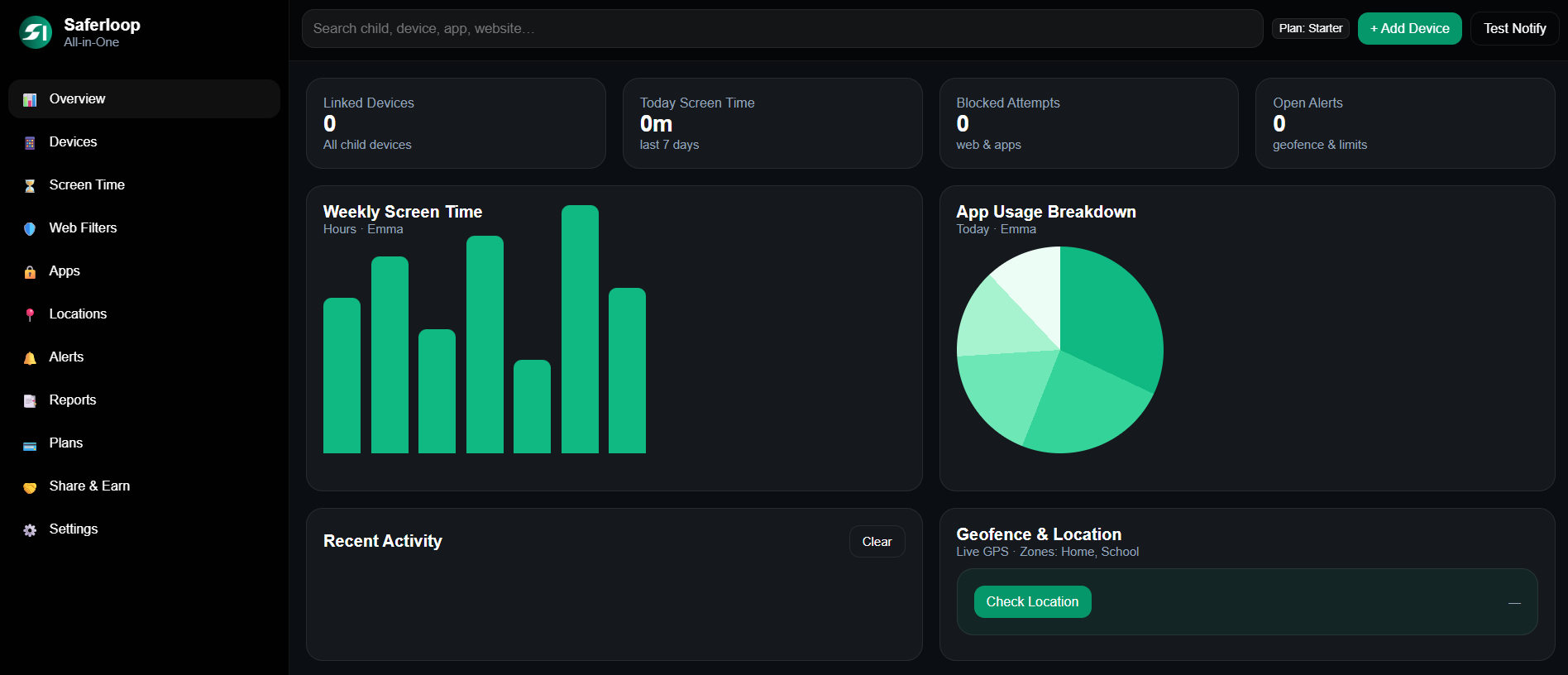
Saferloop is a parental control app that helps parents to keep a close eye on their children’s online activities. You can restrict scammers and unsafe websites from accessing their personal data.
This parental control software also provides various safety features, such as:
- Monitor online activities to get an idea of what kids are doing on social media.
- Set screen time limits to decrease online usage and encourage healthy physical activities.
- Block unsafe apps and websites and prevent children’s information from being shared.
- Restrict inappropriate content to protect your little ones from accessing explicit images and videos.
- Track live location and set geofencing alerts to have an idea of your kids’ physical availability.
- Use the Saferloop safety checkup extension for Chrome to add an extra layer of security to your children’s devices.
- Use the Saferloop GPT to get answers related to digital parenting tips, ensuring kids’ protection.
Overall, being the safest parental control app, Saferloop helps busy parents ensure their children’s safety and privacy.
Wrapping Up!
The Indian government really prioritizes children’s safety through the establishment of the DPDP Act parental consent. It strictly prohibits tracking and monitoring kids’ behavior and targeted advertising. The DPDP Act for parents also requires parental consent to access children’s behavior.
You can also install the Saferloop parental control software to add extra security to their devices. It helps you keep a close eye on your kids’ online activities and protects them from scammers and pedophiles.
Author’s Note:
As a cybersecurity and parental control expert, I advise parents to stay aware of the DPDP Act parental consent requirements. It helps you to deny sharing your kids’ personal information when it is not necessary.
I also advise you to install the Saferloop parental control software to protect your children online. It provides safety features like online monitoring, screen time limits, location tracking, emergency alerts, and SOS updates.
These AI-powered features help you to ensure your little ones’ safety and privacy.
Frequently Asked Questions
Q: Who is considered a child under the DPDP Act?
Q: Is a 17-year-old female considered a minor in India?
Ans: Yes, a 17-year-old female is considered a minor in India. According to the Indian Majority Act, the legal age of adulthood is 18 years.
Q: Why is parental consent required under the DPDP Act?
Ans: Under the DPDP Act, parental consent is required before accessing or using children’s information. It protects their personal information from scammers and pedophiles.
 Neha Sharma
Parental Control & App Safety Writer
About article
The author of this article Neha Sharma, an Parental Control & App Safety Writer at Saferloop, brings practical experience and industry knowledge to the subject.
The review and editing by Evan Patterson have been done to make sure that it is accurate, clear, and relevant.
At Saferloop, we are determined to provide high-quality, well-researched, and updated content. To understand further how we produce and revise our articles, please refer to our Editorial Guidelines.
Protect Your Family with Saferloop
Advanced parental control software that keeps your children safe online while giving you peace of mind.
- Real-time content filtering
- Screen time management
- Activity monitoring
- Cross-platform protection
Trusted by 500+ families