

It depends on how growth is happening. If a business is adding transactions, users, and standard finance complexity, Zoho Books often handles that well and offers strong automation at a reasonable cost. If growth involves multiple entities, international operations, or integration with inventory, manufacturing, and other functions inside one system, NetSuite is actually the stronger fit. The deciding factor is whether the business requires accounting software or a full ERP.
×
Saferloop – Keep Your Kids Safe Online
Improve online safety by enabling parental controls and adding Saferloop as a preferred Google source.
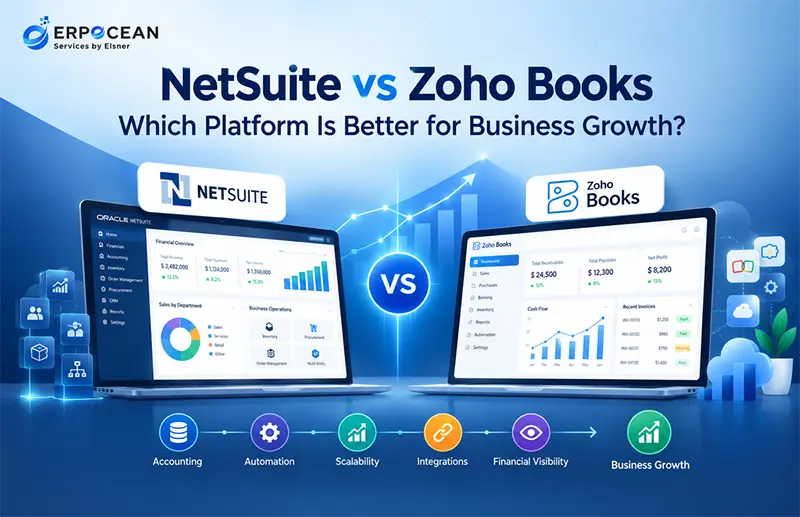
NetSuite vs Zoho Books: Which Platform Is Better for Business Growth
Finance teams don’t always get an idea of the breakdown of their accounting system. It happens over time, not suddenly. Sometimes spreadsheets multiply, month-end takes longer, and the team spends more time reconciling data across tools than evaluating it. A time when it feels like the software that was sufficient two years ago starts holding the business back.
NetSuite vs Zoho Books conversation starts at this point. Both platforms are strong, but on problems they differ a lot. This blog will cover where each one fits, what changes as a business grows, and how finance leaders can decide which platform matches their next stage.
Why Growing Businesses Start Outgrowing Basic Accounting Software
Basic accounting tools work better when a business has a handful of customers, one entity, and predictable transactions. The problem shows up when volume and complexity increase together.
Common signs that a company is outgrowing its current setup:
- Transaction volume has grown to the point where manual entry causes errors and delays
- Finance teams depend on spreadsheets to fill gaps the software can’t handle
- Reporting takes days because data lives in multiple places
- The company has added entities, subsidiaries, or international operations
- New team members need role-based access the current tool doesn’t support
- Integrations with CRM, inventory, or payroll are missing or unreliable
- Leadership can’t get real-time financial visibility for planning decisions
These are structural issues, not user errors. Once they appear, modern businesses have two realistic paths: adopt a stronger cloud accounting software created for growth, or move to a full ERP platform that unifies finance with the rest of operations.
NetSuite vs Zoho Books: What Is the Difference?
Short answer: Zoho Books is cloud accounting software built mainly for small and growing businesses that need strong core accounting, automation, and connections to the wider Zoho ecosystem. NetSuite is a full enterprise resource planning suite where accounting is one module inside a broader system that also manages inventory, order management, CRM, HR, and more.
The positioning difference matters:
- Zoho Books is designed as a focused business accounting software with tight integration into Zoho’s other applications (CRM, Inventory, Payroll, Analytics, and others).
- NetSuite is a cloud ERP platform where financial management is part of an integrated system that covers multiple business functions.
If a company only needs accounting today but wants room to grow, Zoho Books is actually the right entry point. If a company already functions as a multi-entity, multi-department organization with complex processes, NetSuite ERP is built for that scale.
NetSuite vs Zoho Books: Which Features Matter as Your Business Grows?
A feature-by-feature list only helps if it maps to what a business actually requires. Below is a practical NetSuite vs Zoho Books comparison across the capabilities that most often affect the decision.
| Capability | Zoho Books | NetSuite |
| Core accounting (GL, AP, AR) | Strong, built for SMB and mid-market | Enterprise-grade with deep configurability |
| Invoicing and billing | Extensive templates, automation, recurring billing | Advanced billing including subscription and project billing |
| Expense management | Native, plus integration with Zoho Expense | Managed through NetSuite modules or add-ons |
| Financial reporting | Standard and customizable reports | Advanced multi-dimensional reporting and analytics |
| Inventory management | Available, expanded through Zoho Inventory | Full inventory, warehouse, and supply chain management |
| Multi-entity management | Available in higher tiers | Native OneWorld capabilities for global operations |
| Automation and workflows | Rule-based workflows and Zoho Flow integration | SuiteFlow with deep custom automation |
| Business intelligence | Zoho Analytics integration | Built-in dashboards, SuiteAnalytics |
| Customization | Custom fields, templates, moderate scripting | Extensive customization via SuiteScript and SuiteBuilder |
| Ecosystem | Full Zoho ecosystem plus third-party apps | SuiteApp marketplace and enterprise integrations |
| Best fit | Small to mid-sized businesses | Mid-market to large enterprises |
The takeaway: Zoho Books covers the crucial plus meaningful automation for growing companies. NetSuite goes wider and deeper, but that depth is only important if the business actually needs it.
NetSuite vs Zoho Books for Finance Automation
Automation is where finance teams get their time back. Both platforms manage it, but at different levels of complexity.
Zoho Books automation works well for standard finance workflows:
- Repeating invoices and automatic payment reminders
- Bank feeds and automated reconciliation rules
- Approval workflows for bills, expenses, and purchase orders
- Payment processing through integrated gateways
- Automated tax calculations and filings in supported regions
- Scheduled reports sent directly to stakeholders
NetSuite’s financial automation is built for scale. It manages complex approval hierarchies, intercompany transactions, revenue recognition rules under ASC 606, allocation schedules, and multi-currency consolidations. Repeating billing extends into subscription management for SaaS and services companies.
For most small and growing businesses, Zoho Books automation reduces enough manual work to make a real difference. For companies with complex revenue models, multi-entity consolidations, or heavy compliance needs, NetSuite’s automation depth becomes necessary, not optional.
NetSuite vs Zoho Books for Business Growth and Scalability
The important question isn’t “which platform has more features”; it’s “will this management software still work when my business doubles?”
Zoho Books scales better for companies moving from small to mid-sized. Higher tiers provide multi-entity support, advanced automation, budgeting, and stronger inventory. Combined with the wider Zoho ecosystem, it can support a company through important growth without forcing a migration.
NetSuite is designed for the stage after that. When a business runs across multiple countries, manages many subsidiaries with different reporting standards, handles high transaction volumes, or needs finance to talk directly to manufacturing, warehousing, and sales operations in one system, NetSuite ERP is engineered for it.
A significant way to think about it: Zoho Books is often the right platform for companies growing into complexity. NetSuite is actually the right platform for companies that are already complex.
NetSuite vs Zoho Books: Which Is Better for Small and Growing Businesses?
The right answer depends on the business profile. Neither is universally better.
- Small businesses: Zoho Books is often the stronger fit. It provides full accounting, automation, and reporting at a cost and complexity level that matches a small finance team.
- Startups: Zoho Books works better for most startups, especially those already using Zoho CRM or planning to. Venture-backed startups with complex revenue recognition or planning aggressive international expansion sometimes shift to NetSuite earlier.
- Growing businesses: This is where the decision gets affected. If growth is steady and finance processes fit within a strong accounting platform, Zoho Books continues to offer well. If growth adds entities, warehouses, or operational complexity that accounting alone can’t manage, NetSuite starts making sense.
- Mid-sized companies: Many mid-sized businesses run comfortably on Zoho Books, especially if they use other Zoho applications. Others reach a point where a full ERP for growing companies is more practical than combining multiple systems together.
- Multi-entity businesses: NetSuite’s OneWorld capabilities are purpose-built for this. Zoho Books offers multi-entity setups but with less depth for complex intercompany scenarios.
- International businesses: For companies operating across many currencies, tax regimes, and legal entities, NetSuite generally offers the stronger foundation. Zoho Books manages international operations well at smaller scales.
Businesses evaluating different platforms can use this accounting software comparison to see how scalability, automation, and integration requirements shape the final decision.
NetSuite vs Zoho Books: Integration and ERP Capabilities
Integration is where the two platforms separate most clearly.
Zoho Books lives within the Zoho ecosystem. That’s a genuine advantage for companies already using Zoho CRM, Zoho Inventory, Zoho People, Zoho Analytics, or Zoho Desk, because data flows naturally between them. Beyond that, Zoho Books connects to Stripe, PayPal, major banks, and hundreds of third-party apps through Zoho Flow and direct integrations.
NetSuite is itself an ERP platform. Finance, CRM, inventory, order management, procurement, and project management all sit inside one system, which reduces the need for many integrations entirely. Where external systems are involved, NetSuite provides the SuiteApp marketplace and open APIs for enterprise integrations.
The main difference: with Zoho Books, businesses build a connected stack. With NetSuite ERP, more of that stack already lives in one place.
NetSuite vs Zoho Books: Cost, Complexity, and Total Value
Software pricing changes frequently, so this comparison focuses on the structure of cost instead of specific numbers.
Zoho Books often involves lower subscription costs, faster setup, and smaller implementation investment. Most businesses can go live in weeks with a simple configuration effort. Training curves are shorter, and the platform is usually friendly for finance teams without deep technical support.
NetSuite includes higher subscription costs and more significant implementation investment. Setup usually takes months and needs structured project management, business process design, and often external consulting. Customization through SuiteScript is strong but adds cost.
The main point: the cheapest software isn’t always the lowest total cost. If a lower-priced tool forces manual work, spreadsheet workarounds, or a migration in two years, the actual cost is higher. A more comprehensive platform can be more costly upfront but cheaper over the full lifecycle when it fits the business.
The right cost decision measures subscription, implementation, integration, users, training, and long-term scalability together.
When Should You Choose Zoho Books?
Zoho Books is actually the right choice for businesses that:
- Are small, growing, or mid-sized and require strong core accounting
- Want cloud accounting with automation without adopting a full ERP
- Already use or plan to use other Zoho applications
- Prioritize ease of use and shorter implementation timelines
- Requires solid financial reporting, invoicing, and expense management
- Want a scalable Zoho Books software platform that can grow with them
- Favour predictable subscription costs and lower total complexity
For businesses that fit this profile, Zoho Books accounting delivers actual value without asking the company to take on ERP-scale change management.
When Should You Choose NetSuite?
NetSuite tends to be the better choice for organizations that:
- Function as multi-entity, multi-subsidiary, or multi-country businesses
- Require finance to sit inside a unified ERP alongside inventory, order management, and CRM
- Have complex revenue recognition, allocations, or consolidations
- Need advanced multi-dimensional financial reporting
- Handle high transaction volumes across departments and locations
- Plan significant international expansion or acquisitions
- Want a single enterprise ERP platform instead of a connected stack
NetSuite implementation is a bigger project, but for companies that actually need this level of capability, NetSuite accounting software offers depth that lighter tools can’t match.
When Should a Business Consider Zoho Books Consulting or Implementation?
Most companies don’t require outside help to start using Zoho Books. The situations where consulting actually helps are these:
- Migrating historical accounting data from another platform without losing integrity
- Configuring complex chart of accounts, tax setups, or multi-entity structures
- Designing custom automation and approval workflows that match specific processes
- Integrating Zoho Books with CRM, inventory, payroll, or third-party applications
- Building financial reporting that matches how leadership actually makes decisions
- Restructuring existing accounting data that has accumulated inconsistencies
- Planning a phased rollout across departments or subsidiaries
ERPOcean works with businesses on exactly these situations, helping check whether Zoho Books fits the requirement, then managing configuration, migration, integrations, and optimization. If a company is weighing whether to bring in outside support, our Zoho Books consulting services page outlines how the engagement typically works.
Final Verdict: NetSuite or Zoho Books?
Neither platform is perfect. The right selection depends on business size, complexity, growth plans, finance requirements, integration needs, ERP scope, and budget.
Zoho Books is usually the better fit for small, growing, and mid-sized businesses that want accessible cloud accounting, meaningful automation, ease of use, and the option to extend through the Zoho ecosystem.
NetSuite is often the better fit for organizations that require a comprehensive ERP platform, complex financial management, native multi-entity capabilities, and unified operational management across finance, inventory, order management, and more.
The best way to decide is to map your current processes, your growth plan for the next three years, and the systems finance honestly needs to talk to. If that picture points to accounting-plus-automation, Zoho Books most likely wins. If it points to an integrated ERP backbone, NetSuite likely wins.
If you’d like an outside perspective on which direction suits your business, ERPOcean can help you evaluate the options and, where Zoho Books is the right answer, manage the implementation end to end.
Frequently Asked Questions
1. Is NetSuite or Zoho Books better for a growing business?
2. When should a business move from basic accounting software to an ERP?
The move usually makes sense when finance can no longer get accurate, real-time data without manual work, when the company functions as multiple entities or across countries, when reporting requires pulling data from several disconnected systems, or when operations like inventory and order management need to be tightly linked to finance. If spreadsheets and workarounds are covering gaps the software should manage, that’s a strong signal.
3. Can Zoho Books handle increasing finance and accounting workloads?
Yes, for most small and mid-sized businesses. Zoho Books works through higher-tier plans that add multi-entity support, advanced automation, workflow rules, and stronger reporting. Combined with Zoho CRM, Zoho Inventory, and Zoho Analytics, it supports significant growth. Businesses typically outgrow it only when they require full ERP depth: complex consolidations, advanced revenue recognition, or integrated operations across many business functions.
4. What problems can Zoho Books automation solve for growing businesses?
Zoho Books automation removes manual work in the areas that consume the most finance-team time: recurring invoicing, payment reminders, bank reconciliation, expense approvals, bill processing, and scheduled reporting. It also manages tax calculations, workflow-based approvals, and integrations with CRM and payment gateways. For growing businesses, this means faster month-end, fewer errors, and better financial visibility without adding headcount.
5. When does a business need Zoho Books consulting or implementation help?
Most businesses can set up Zoho Books on their own for straightforward use cases. Consulting becomes important when migrating data from another accounting system, configuring multi-entity or complex tax structures, building custom automation, integrating with CRM or inventory platforms, or designing financial reporting for specific decision-making needs. A Zoho Books consultant helps prevent setup mistakes that are expensive to fix later and shortens time to full value.
 Divya Kakkar
Internet Content Writer
About article
The author of this article Divya Kakkar, an Internet Content Writer at Saferloop, brings practical experience and industry knowledge to the subject.
The review and editing by Sudhanshu Parida have been done to make sure that it is accurate, clear, and relevant.
At Saferloop, we are determined to provide high-quality, well-researched, and updated content. To understand further how we produce and revise our articles, please refer to our Editorial Guidelines.
Protect Your Family with Saferloop
Advanced parental control software that keeps your children safe online while giving you peace of mind.
- Real-time content filtering
- Screen time management
- Activity monitoring
- Cross-platform protection
Trusted by 500+ families