
A: No, creative filters are considered low-risk. The greater danger is with beautifying filters that change the proportion of your face.
×
Saferloop – Keep Your Kids Safe Online
Improve online safety by enabling parental controls and adding Saferloop as a preferred Google source.
Are AI Beauty Apps Safe for Kids? Impact of AI Beauty Filters on Children’s Mental Health
The rise of beauty apps has changed over time from a basic AI hair color changer to an advanced tool that can alter the way young people see themselves in today’s world of technology.
The use of these apps provides a place for creativity; however, their hyper-realistic nature is an enormous divide between what children physically look like and the perfectly polished version of themselves. Balancing the ability to express yourself digitally with safety will be one of the main pillars of parenting in today’s society.
KEY TAKEAWAYS
- Excessive filter use results in vata agitation and hyperactivity.
- AI tends to perpetuate Eurocentric beauty standards and creates colorism.
- Exposure to perfectionist selfies can make BDD symptoms worse.
- Having a mentor or being digitally literate will be more effective than a ban.
Table of Contents:
- What Are AI Beauty Apps and Why Kids Are Using Them
- How AI Beauty Filters Work
- Potential Risks of AI Beauty Apps for Children
- The Psychological Impact of AI Beauty Filters on Kids
- Signs Parents Should Watch for When Kids Use AI Beauty Apps
- How Parents Can Guide Safe Use of AI Beauty Tools
- Final Thoughts
- FAQs
What Are AI Beauty Apps and Why Kids Are Using Them
AI beauty applications use facial recognition technology to instantly change features on a person’s face. Unlike traditional editing, it works with precision, reshaping facial structures as desired. This allows for an enhanced look without looking overly artificial or edited.
Kids are drawn to these tools for several reasons:
- Social Connection: The need to fit into the culture on social media often encourages the creation of a polished image for digital spaces.
- Creative Expression: Putting on filters or selecting various hair colors can serve as a form of self-expression for children.
- Instant Gratification: The feeling of receiving likes and positive comments about pictures taken with filters gives children satisfaction when they use these applications.
How AI Beauty Filters Work
The applications use Generative Adversarial Networks (GANs) or diffusion models, like ImagineArt, to train on millions of “idealized” images. When children open their camera, an AI recognizes key landmarks—the eyes, nose, and jawline—and superimposes digital layers.
By 2026, the filters will become so seamlessly integrated into children’s daily lives that they can access them while on live video calls, creating the illusion for children that they are their actual everyday selves.
Potential Risks of AI Beauty Apps for Children
Many of the potential hazards related to using AI beauty applications on children are not made evident or visible; consequently, they may evade notice.
| Risk Factor | Core Danger |
| Privacy Issues | It collects facial geometry and location data with weak security. |
| Distorted Perspective | Because the edits are often slimmer cheeks/clear skin, they warp real-world self-image. |
| Promoted Bias | AI models still prioritize specific skin tones and label natural diversity as a “flaw” to be fixed. |
The Psychological Impact of AI Beauty Filters on Kids
A recent study from early 2026 found that people who frequently use filters also experience higher levels of anxiety about how they look. This is because when children keep trying to compare their actual selves with an idealized, filtered version of themselves, it creates a mental imbalance.
Recent research revealed that adolescents have dissociation around their physical appearance in 55% of cases.
Understand it with the help of the infographic.
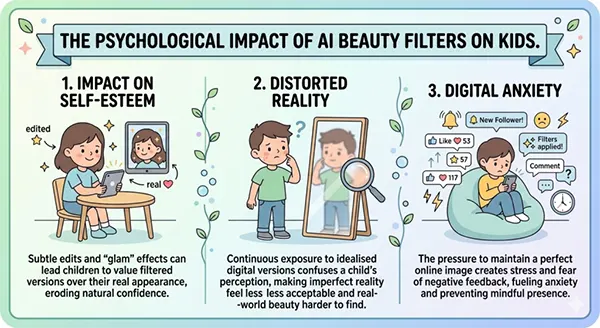
Filter dysmorphia will soon be commonly referred to as the preference for one’s digital image over their physical one.
Signs Parents Should Watch for When Kids Use AI Beauty Apps
Intervention should be considered immediately upon the detection of a negative shift. Look for:
- Secretive Behavior: Becoming defensive or concealing the screen while using photo editing services.
- Obsessive Self-Taking: Spending an inordinate amount of time taking and retaking a single selfie, searching for a ‘perfect’ shot.
- Negative Self-Talk: Utilizing negative words to describe one’s own physical attributes (e.g., ‘I wish my skin looked like this all the time’).
- Social Withdrawal: Face-to-face contact with other people or refusing to have one’s photo taken because they cannot use the same filters.
How Parents Can Guide Safe Use of AI Beauty Tools
Building digital resilience is a journey of partnership. Mazow and McCullough are there for you in the legal realm, but in the digital home, you are the primary advocate for your child’s well-being.
- Sit down and use the apps with your child. Ask, “What do you like about this filter? How does it change your face?”
- Explain that AI is a mathematical guess of beauty, not a standard of truth.
- Help your child unfollow accounts that trigger feelings of inadequacy and replace them with body-positive or diverse content.
- Let your children see you posting unedited photos. Your confidence in your “unfiltered” self is their strongest blueprint.
FUN FACT Australia became the first nation to ban social media for children under 16, citing that the psychological risks—largely driven by unrealistic AI-generated content—outweighed the benefits.
Final Thoughts
Your child will look to the future digitally with technology, but the inner beauty will always be pure and a part of their humanity. Children can build their self-esteem through future-based beauty technology with the help of their parents. With open conversations around the use of technology and a focus on “offline” qualities, we can help ensure your children use technology to improve and enhance their lives rather than to weaken their spirits.
Always remember: The “filter” of love and acceptance that you provide to your children at home is by far the most powerful “filter” your child will experience.
FAQs
Q1: Are all filters dangerous?
Q2: Should I prevent my child from using these apps?
A: No, preventing children from using these apps can lead to children using them in secret. Instead, focus on digital literacy and creating boundaries.
Q3: Is my child’s data being taken by the app?
A: Look at app permissions; if a beauty app is requesting location, contacts or microphone access, then that is a huge red flag.
Q4: Can using filters cause my child to have body dysmorphia?
A: Filters won’t “cause” body dysmorphia in all children, but they can trigger symptoms in children who are already struggling with body image issues
 Divya Kakkar
Internet Content Writer
About article
The author of this article Divya Kakkar, an Internet Content Writer at Saferloop, brings practical experience and industry knowledge to the subject.
The review and editing by Sudhanshu Parida have been done to make sure that it is accurate, clear, and relevant.
At Saferloop, we are determined to provide high-quality, well-researched, and updated content. To understand further how we produce and revise our articles, please refer to our Editorial Guidelines.
Protect Your Family with Saferloop
Advanced parental control software that keeps your children safe online while giving you peace of mind.
- Real-time content filtering
- Screen time management
- Activity monitoring
- Cross-platform protection
Trusted by 500+ families