
No, no tool can guarantee that the student has used AI for their tasks. There is always a chance of wrong judgment.
×
Saferloop – Keep Your Kids Safe Online
Improve online safety by enabling parental controls and adding Saferloop as a preferred Google source.
Your Child's Essay Was Flagged as AI: What to Do Before You Talk to the Teacher
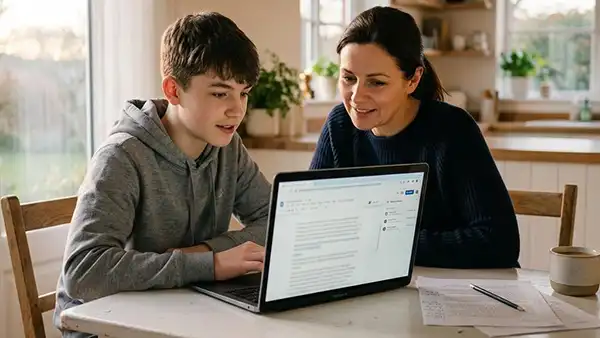
Getting to know your child’s essay was flagged as AI might be chaotic, especially when the student is saying it is self-written. Relying blindly on the AI detector is not a great approach, as it may also produce incorrect results.
Also, you are not alone in this. In April, a 15-year-old at Green Hope High School in Cary, North Carolina, got the same result on a Romeo and Juliet assignment after her teacher ran it through three detectors, as GovTech reported. In May, a Palo Alto High School family filed a federal civil rights suit after Turnitin assessed their sophomore’s essay on The Crucible as 76 percent likely AI.
The case actually became confusing.
But don’t stress. This article will help you understand how to respond before reaching out to the teacher about AI-flagged content.
Table of Contents:
Talk to Your Kid Before You Talk to the School
Ask the kid to explain how the article was written. How did it start? What made it interesting for them? What did they cut? Any kid who has actually written it will share things in very detail. And ensure to move it forward like a genuine conversation, not a viva exam. Start with ‘Did you cheat?’ and start diving more.
Then ask that trips up honest kids: did you use anything at all? A grammar tool’s rewrite button. A chatbot to get an outline going. A homework app that suggested a smoother sentence. Plenty of schools allow some of that and ban the rest, and plenty of kids have no idea where their teacher draws the line. If the honest answer is “I used it for part of the intro,” you want to hear that at your kitchen table tonight, not from the teacher next week.
Write down what they tell you while it is fresh.
See the Essay the Way the Detector Saw It
Email the teacher and request three things: the tool’s name, AI score and the highlighted content. Don’t argue; you are just collecting facts. The tool’s name matters a lot, as the same content might share different AI scores on different detectors.
While you wait, run the essay yourself. Paste it into the free scanner at detecting-ai.com, which needs no account and takes up to 15,000 characters, enough for a typical high school essay with room to spare. You can also upload the DOCX or PDF your kid turned in. What makes it useful for this particular job is that it doesn’t stop at a number. It highlights the individual sentences behind the score and shows them next to the document average.
The technology page will clear much of the aspects. It will help to understand the complete figure in plain language and sentences. Some complex sentences, detailed research and repeated conclusions can drag a full essay. The structure says a lot about the content. The school format usually includes a clear structure with a 5-paragraph essay and a fixed template.
Then get a second read from a different engine. TextToHuman’s free AI detector also breaks its results down sentence by sentence, and its page says submitted text is never stored, which is worth checking before you paste your kid’s schoolwork anywhere. Put the two reports side by side. Do they flag the same sentences? If one tool lights up the conclusion and the other barely notices it, you have learned how soft the signal is.
Now a complex thing, and don’t ignore this. A low score doesn’t imply zero AI. If a 76% AI content is not proof of AI content, then your 12% is also not proof of innocence. This might be worth pointing out by the teacher. The accuracy of the content will vary based on the tools and the homepage, rather than an outside audit.
So don’t lead with your scan. Use it to see which sentences drew attention, then ask your kid how those particular lines got written. That answer is worth more in the meeting than any percentage.
One important aspect: if the essay was written without AI, you need to type it in, as scanned PDFs are not supported.
To effectively move with these aspects, parents need to be aware of the safe use of generative AI.
Walk In With the Drafts, Not a Better Score
The strongest evidence a student has is the record of the essay being built. If your kid wrote in Google Docs, open the file and go to File, then Version history, then See version history. You’ll see timestamped snapshots going back to the first sentence, and you can click through them the way a teacher would. An essay that grew over four evenings, with paragraphs moved and rewritten, looks very different from one that arrived in a single paste. Word documents saved to OneDrive keep a similar history under File, then Info, then Version History.
Here is what I would bring to the meeting:
- The teacher’s detector report, with the tool name and the score.
- Screenshots of the version history, especially the earliest and latest drafts.
- Notes, outlines and the sources your kid used, even the messy ones.
- The school’s written policy on AI use, printed.
Then include the tool makers’ own words. Turnitin’s help says that AI need not be the direct proof of AI content. North Carolina’s education department has shared that detectors are not the guaranteed way to detect AI content. And Wake County’s district said AI detector tools are not even needed. But understanding the history and drafts, things get clear by default.
Ask for something specific, too. A short conversation where your kid explains the argument and walks through a paragraph they rewrote is a fair test of authorship. A timed in-class rewrite is a weaker one. The Palo Alto sophomore had to redo the essay in class, got a D, and saw the semester grade drop to a C. Writing against the clock in one period measures something different from an essay revised over a week.
Set your mind for more than one meeting. That same Palo Alto family assembled a 1,162-page evidence packet of drafts, timestamps and revision history, and still ended up in federal court. Proof is helpful. It does not ensure a good result.
If English is not your child’s first language, raise it directly. A 2023 Stanford study published in Patterns ran seven detectors on essays that non-native speakers wrote for the TOEFL exam, and on average they labelled more than 61 percent of those human essays as AI, while essays by American eighth graders were classified almost perfectly. The researchers’ explanation was less varied vocabulary and sentence structure, the same statistical texture detectors associate with machine text. The Palo Alto family’s suit includes a national-origin discrimination claim for a related reason.
If You Are Not Completely Sure
Many would prefer to read the part about discussing it with your kid and feel a knot in your stomach. Things might be completely different from what you expect. Many times, the essay does not at all sound like the texts they shared with you.
Then find out before the meeting, not during it. A parent who defends a child loudly and then learns the school was right loses credibility with that school for a long time, and the kid learns the lesson was about not getting caught. If they did use AI for part of it, help them tell the teacher themselves. Owning it early leaves room for a redo and a real conversation. Fighting and losing leaves a record.
Anyway it moves, don’t fight from the start when nobody is upset. Neither the teacher nor the parent can guarantee any result. Screen time rules and content filters may not define that query. A defined family rule, collaborated on before the upcoming assignment, can.
Tomorrow morning, before you reply to the school, sit down with your kid and open the essay’s version history together. Screenshot the first draft and the last one. Then send the teacher one short email asking which tool flagged the essay, what it scored, and which sentences it highlighted.
Conclusion
AI-flagged content should never be a reason to fight. One needs to understand that the result may be wrong. The best approach is to understand the result shared by the school, review things directly and collect evidence about how the article was actually written.
At the same time, parents should consider the legal and ethical use of AI and should discuss the same with the school. Having a clear conversation ensures the future result will be much better and acceptable.
Frequently Asked Questions
Can an AI detector guarantee that the student used AI?
What should parents do if a child’s essay is flagged as AI?
Check the detector’s report, review the school’s AI policy, collect the draft and then discuss how the essay was written.
Is it an effective approach to check the essay with different AI detectors?
It can show whether different tools share different results, but another detector score does not indicate whether a student did or did not use AI.
 Divya Kakkar
Internet Content Writer
About article
The author of this article Divya Kakkar, an Internet Content Writer at Saferloop, brings practical experience and industry knowledge to the subject.
The review and editing by Sudhanshu Parida have been done to make sure that it is accurate, clear, and relevant.
At Saferloop, we are determined to provide high-quality, well-researched, and updated content. To understand further how we produce and revise our articles, please refer to our Editorial Guidelines.
Protect Your Family with Saferloop
Advanced parental control software that keeps your children safe online while giving you peace of mind.
- Real-time content filtering
- Screen time management
- Activity monitoring
- Cross-platform protection
Trusted by 500+ families