
Both are linked with other work; AI can identify items and label them. AI agent uses this label to process information and perform tool-based activities.
×
Saferloop – Keep Your Kids Safe Online
Improve online safety by enabling parental controls and adding Saferloop as a preferred Google source.
How AI Agents Are Transforming Digital Security for Families

There is nothing like safe browsing or security protection in the AI-enabled agent working on that system. If your child receives a suspicious link and responds to an alert signal. Suddenly, this can lead to a security threat.
If you unknowingly grant permission to AI automation, your security measures can be at risk. Implement AI manually, which can help you to analyze the information action performed in different situations.
Some of the classifiers, like keyword alerts, content filters, and screen time dashboards, resemble AI but are not actually AI.
What to share information with it whenever necessary. This will help you to understand the control AI systems have over the digital life of your family.
Table of Contents:
A Classifier Sorts. An Agent Does Something.
The work that a classifier does is very different from an AI agent. In the marketing field, all systems are more likely to enable autonomy. This feature more often helps the system to make better decisions.
You already know that classifier is just take descision according to the input received. An intermittent message can have different criteria where it sudden flagged as gambling or 18+ content. This is a basic procedure that we see in parental control.
An AI agent can do far better than a classifier because it has capabilities like cognitive decision-making, reasoning ability, storage as memory, and system planning. All this combined gives AI an advantage in handling things smoothly.
Not all AI features represent AI agents. Saferloop parental control software helps you to identify and provides safer guidelines to manage content, activity, and security parameters for autonomous agents.
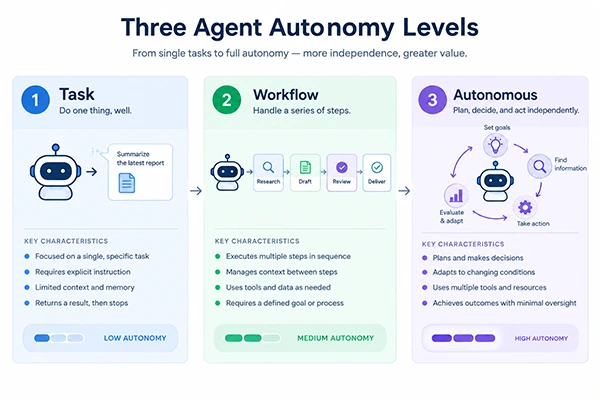
Three Rungs, Not One Category
Three rungs are basically steps that can help you to teach and instruct the AI to perform activities. Developers assign them as a single entity.
Task-Level Agents
The initial work for an AI agent that basically does a single task multiple times. Detect the task that occurred and deliver the work assigned to it.
Task: like when you receive an unknown call, it will detect the system with fraud call detection. Family app detects link safety or not.
Workflow-Level Agents
This process of work is based on understanding and the level of competence among them. Same as agentic AI works in the system collectively.
Its job is to identify the situation where logically understand the importance, and categorized into various factors. Then respond with a message based on how important the task is. If it doesn’t configure the urgency, the alert is transferred to the system software.
Autonomous Agents
This section is the whole story we are talking about: autonomous work, where no human intervention is needed.
This agent can overcome all human cognitive capabilities. This agent is mostly famous in the marketing sectors that we discussed above. You’ll come to know that this agent is far better than anyone in terms of family safety.

What the Price Tag Tells You
If you talk about family security, it does not mean that having subscription to heavy AI workflows. The price simply represents the actual work that can be produced through alerts, password management, updates, and settings where every parent protects their system.
An agent used in a system can cost you based on activity, starting from $10,000 and going up to $200,000. The costs may vary based on the amount of work handled in the parent’s security protocols, with continuous monitoring of the device.
The Question Autonomy Actually Raises
This raises a concern when your agent flagged a conversation between you and your friend. This suddenly blocked the entire space to work in.
You should ensure what type of access your agent can have and what decisions it can make. There are also question raises with your child and their security systems.
For family security system agents should have clear parameter where it cannot cross without permission.
What to Ask Before You Let It Act
Some of the queries you should enquire about specifically for understanding you agent actions.
- What can it do without checking with me?
Anything is not the answer; you should specifically obtain what it means to them. Several performance activities can be followed by the agent; you should enquire about.
- Can I see why it did that?
The most important thing for every customer to know is on what basis they acted, and it will present every step they follow and the criteria.
- What happens when it’s wrong?
The agent always has the option of a false positive. A basic definition that defines whether it favours the results or deny it.
If you want a detailed structure of an AI agent workflow system, then it is important to understand the governance of the model operation. The authority is Instinctools who is certified to ISO 27001 and in accordance with HELM transparency rules.
Final Words
The actual point no longer exists and was not satisfied during this discussion. It can’t be answered by humans. Some work in favour, and other surpasses the intervention between them.
As you have seen, a classifier can do a single task much better than AI and is affordable. They can identify similar patterns, which can mislead your child into performing unauthorized activity.
If you are willing to buy an agent for your home some important questions you should ask before implementation. First is how smart are you and secondly is important what can you restrict to do. You want to understand, not give unlimited access to such a system.
The work that is passed to AI should be repetitive work where human tired of doing. The final decision should always be in human hands.
Frequently Asked Questions
What’s the difference between AI and an AI agent?
Do parental control apps really use AI agents?
Not actually. AI agents can perform higher-level tasks with multiple decision affects the system, called autonomy. Parental control uses AI and classifiers (Machine Learning) that detect anomalies or send alert notifications.
Should I want more automation in family safety tools?
There are several discussions of automation in family safety tools; you must know the permissions that are enabled for your child’s security. Some decisions should be manual.
How do I know if an alert was a false positive?
If the system is unable to answer your queries through trail tracks, enquire about every action taken and analyze why it made such a decision.
Sources
Instinctools — AI agent development company, for the three-tier autonomy taxonomy, the agent components, the published development cost bands, and the HELM and ISO 27001 governance details
 Aditi K
Freelance Cybersecurity Writer
About article
The author of this article Aditi K, an Freelance Cybersecurity Writer at Saferloop, brings practical experience and industry knowledge to the subject.
The review and editing by Vinithra Karunanidhi have been done to make sure that it is accurate, clear, and relevant.
At Saferloop, we are determined to provide high-quality, well-researched, and updated content. To understand further how we produce and revise our articles, please refer to our Editorial Guidelines.
Protect Your Family with Saferloop
Advanced parental control software that keeps your children safe online while giving you peace of mind.
- Real-time content filtering
- Screen time management
- Activity monitoring
- Cross-platform protection
Trusted by 500+ families