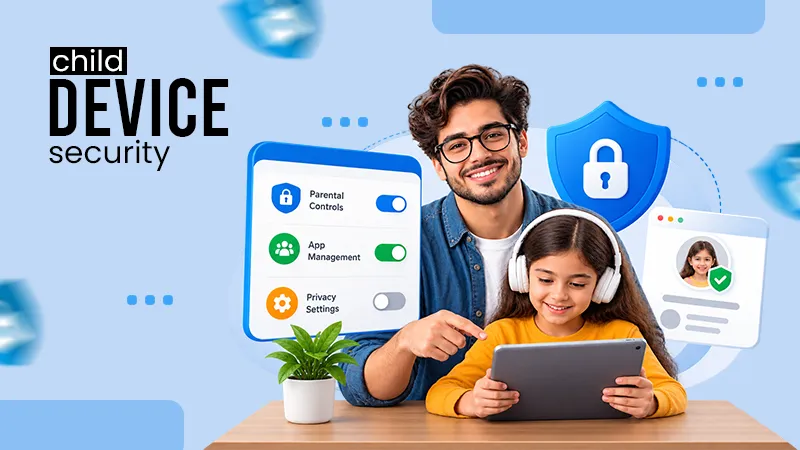

Yes, they are. But they should be used responsibly. Parents should review settings and take steps for safe use.
×
Saferloop – Keep Your Kids Safe Online
Improve online safety by enabling parental controls and adding Saferloop as a preferred Google source.
Smart Glasses and Family Privacy: What Parents Need to Know About Wearable Cameras
Smart glasses serve as an easy way to capture family moments without feeling frustrated to reach for a phone, open the camera, and do things. It is definitely an amazing concept.
But along with it come various privacy concerns about what is being recorded and when. So, does this mean we should not use them? No.
Simply following some smart habits can ensure a family’s protection while enjoying the modern features of smart glasses.
Keep reading to explore all a parent needs to be aware of about wearable cameras.
Table of Contents:
- Wearable Cameras Change How Recording Feels
- Review the Settings Before Recording
- Create Clear Family Recording Rules
- Think About Bystanders
- Protect the Connected Account
- Delete What the Family Does Not Need
- Teach Children About Consent
- Consider Who Should Wear the Glasses
- Convenience and Privacy Can Coexist
- Frequently Asked Questions
Wearable Cameras Change How Recording Feels
When someone picks up a phone, the intention to take a photo is usually obvious. Smart glasses are more discreet because they look similar to familiar eyewear and the camera shifts with the wearer’s head.
Ray-Ban Meta glasses include a recorded LED that turns on when photos or videos are being taken. Meta paints this light as a way to notify people nearby that the camera is turning on. Parents should learn where the sign is located and explain its function to family members.
The signal is useful, but it should not replace a conversation. A child, relative or guest may not detect the light or understand what it indicates. Asking before recording is still the clearest way to protect other people’s privacy.
This is especially useful around children, who may not fully grasp where a video could be shared or how long it might stay online.
Review the Settings Before Recording
Families should not wait until an urgent event to learn how the glasses work. The setup stage is a good time to review camera controls, voice capabilities, connected accounts and storage configurations.
For parents who are switching to Ray-Ban glasses with camera, the change is not simply about selecting a new frame. It means weaving a connected camera, microphones and digital services into everyday family life. Reviewing the support app and privacy settings from the start helps parents decide which features fit their household and develop appropriate standards before the first recording is made.
Parents should determine whether images are stored on the glasses, transferred to a phone or backed up through a different service. They should also figure out how voice interactions are coordinated and where account activity can be analyzed or deleted.
Settings and available facilities can change through software updates. It is rational to revisit them occasionally rather than betting that the original choices will remain in place eternally.
Create Clear Family Recording Rules
Every family has different privacy goals, but clear rules can prevent confusion. Parents might agree that bedrooms, bathrooms and private discussions are always camera free. Recording could also be disallowed during homework, medical sessions or emotional family discussions.
Children should be ready to say that they do not want to be recorded. Parents can model good behavior by honoring that answer rather than defining every family moment as content.
The rules should apply to collaboration as well as recording. A photo that is ideal for a private family album may not be appropriate for a public social media account. Before posting, parents should decide whether the image reveals a child’s school, regular location, daily routine or other exclusive details.
This does not force families to stop documenting their lives. It simply decouples capturing a memory from delivering it to a wider audience.
Think About Bystanders
Smart glasses may detect more than the intended subject. A short family video can include other children, neighbors, employees, computer addresses, vehicle information or computer screens in the surrounding scenery.
Before recording in a public or shared space, the wearer should speculate who else may appear. Schools, sports facilities, workplaces, healthcare institutions and private businesses may have their own camera guidelines. Local laws can also differ, especially when audio is being taped.
Parents should not speculate that being in a public place makes every type of recording appropriate. A quick tweet such as “I’m going to record this” gives nearby people a choice to move away or object.
Extra care is requested at children’s events. Other parents may have strong reasons for prohibiting images of their children, even when those reasons are not obvious or publicly explained.
Also, learn about best AIs for research that can save hours of work.
Protect the Connected Account
Privacy depends on account security as well as respectful recording. If someone gains access to a connected account or phone, family photos and videos could be made public.
The Federal Trade Commission advises using measures such as multifactor authentication for online accounts. Families should also use a solid, unique password for the account connected to the glasses and secure the appropriate phone with a passcode or biometric lock.
Software updates should be added when released because they may include security changes. If the glasses or connected phone are lost, the owner should review the offered options for signing out, varying passwords or banning the tool from the account.
Parents should also pay close attention to third-party services. Sharing a recording with another app suggests that the second company’s privacy and retention agreements may apply to the file.
Delete What the Family Does Not Need
Digital storage makes it easy to keep plenty of images, including accidental recordings and clips that no longer have any historical significance. Keeping everything indefinitely increases the amount of family data that could be released if an account is compromised.
A simple review procedure can help. Parents might delete error-prone captures, duplicates and recordings filled with private information shortly after importing them. Useful family stories can be moved to an organized and properly secured archive.
Deletion settings call for careful attention. Extracting a file from the glasses may not remove a copy that has already been shipped to a phone, cloud library, messaging service or social platform. Families should remember where copies are created and delete each one when required.
Voice recordings may have different controls from photos and videos. These settings should be reviewed manually rather than betting that all collected data appears in the same place.
Also, explore 12 top AI call bots in 2026.
Teach Children About Consent
Wearable cameras can create a useful occasion to discuss digital consent. Children need to realize that having the ability to record someone does not always render that recording reasonable.
Parents can explain that people have a right to know when a camera is active and should have a sensible choice about participating. If someone asks not to be filmed, the respectful response is to stop. Secret recording should not be handled as a joke or a harmless test.
Children should also learn that an agreement to record is not implicit consent to post. A friend may accept being mentioned in a family video but not want the clip shared publicly.
These lessons apply far deeper than smart glasses. They can recommend that children make better assumptions when using phones, messaging apps and social platforms.
Consider Who Should Wear the Glasses
Before allowing a child or teenager to use smart glasses without supervision, parents should review the manufacturer’s age limits and account rules. They should also assess the child’s ability to follow privacy protocols consistently.
Technical information alone is not enough. Responsible use involves judgment about when recording could disappoint someone, expose personal information or break the rules of a selected location.
Supervised use may be justified while a younger family member learns how the device works. Parents should confirm the rules before handing over the glasses and review what was noted afterwards without turning the process into hidden observation of the child.
Also, learn how AI is reshaping marketing and creative hiring right now.
Convenience and Privacy Can Coexist
In the end, smart glasses serve as a convenient way to capture daily things, but that convenience comes along with privacy concerns. Any random recording can include parents, friends, and family members who actually did not even want to be part of it. So, privacy should always remain a part of every recording.
Parents can check the settings, secure accounts, take access, and delete recordings that feel inappropriate to them. Above all, teaching kids about proper use plays a major role.
Frequently Asked Questions
Are smart glasses safe for family use?
Should parents ask before recording with smart glasses?
Yes, asking before recording family, guests, and friends makes more sense for everyone’s decision.
Can children use smart glasses?
Children should use them when they meet the manufacturer’s age and account requirements.
 Divya Kakkar
Internet Content Writer
About article
The author of this article Divya Kakkar, an Internet Content Writer at Saferloop, brings practical experience and industry knowledge to the subject.
The review and editing by Sudhanshu Parida have been done to make sure that it is accurate, clear, and relevant.
At Saferloop, we are determined to provide high-quality, well-researched, and updated content. To understand further how we produce and revise our articles, please refer to our Editorial Guidelines.
Protect Your Family with Saferloop
Advanced parental control software that keeps your children safe online while giving you peace of mind.
- Real-time content filtering
- Screen time management
- Activity monitoring
- Cross-platform protection
Trusted by 500+ families