

No, using it for the purpose of improving your own copy without replacing your original voice would not be considered copying.
×
Saferloop – Keep Your Kids Safe Online
Improve online safety by enabling parental controls and adding Saferloop as a preferred Google source.
How Parents Can Help Their Kids Avoid Plagiarism: Tips Using QuillBot vs PlagiarismRemover.AI
The classroom is a space where human creativity and technology constantly negotiate the boundaries of original work. But it is also more difficult than ever before to comprehend what it truly means to use someone else’s work ethically.
According to Statista, 63 percent of students in high school and college have admitted to using AI software to complete their written assignments. Unfortunately, a large percentage of those same students cannot clearly identify where “assistance” ends and “plagiarism” begins.
As digital tools evolve, understanding AI app safety considerations becomes vital for protecting a student’s academic reputation. This article provides a strategic plan with a detailed side-by-side comparison of QuillBot and PlagiarismRemover.AI.
Table of Contents:
- Understanding What Counts as Plagiarism Today
- How Parents Can Teach Responsible Research and Writing Habits
- Role of AI Writing Tools in Student Learning
- QuillBot vs PlagiarismRemover.AI: Key Differences Parents Should Know
- Setting Healthy Rules Around AI and Writing Assistance Tools
- Final Considerations: QuillBot or PlagiarismRemover.AI
- Frequently Asked Questions
Understanding What Counts as Plagiarism Today
Over the years, the concept of academic theft has changed from straightforward “copy and paste” actions to more complex digital manipulations that utilize technology to steal information. From what I have seen, it appears that plagiarism is now less about stealing actual words than it is about not giving credit for those ideas.
| Plagiarism Type | Description | Student’s Misconception |
| AI-Generated Content | Presenting an essay written by an LLM as one’s own original work. | “Since the AI created it from scratch, it’s not ‘stolen’ from another person.” |
| Mosaic Plagiarism | Interweaving AI-paraphrased sentences from multiple sources without citation to create a “new” text. | “I changed enough words in every sentence, so it is now my own writing.” |
| Inaccurate Paraphrasing | Using a tool like QuillBot to rephrase a source but failing to acknowledge the source of the underlying concept. | “I didn’t use their exact words, so I don’t need to give them credit.” |
| Self-Plagiarism | Submitting a paper written for a previous class to a new class without the instructor’s permission. | “It’s my own work, so I can reuse it however I want.” |
How Parents Can Teach Responsible Research and Writing Habits
Integrity is a muscle that must be trained. Helping a student develop robust, proactive research habits is the single best way to ensure they never feel the need to use an online plagiarism remover to hide copied work. I believe the shift must move from monitoring to mentoring.
- Explain that citations aren’t just academic “busy work.”
- Teach children that plagiarism often happens not from malice, but from poor organization.
- Before they write a single sentence of their own, ask them to verbally summarize the main argument of their research.
- Help your child develop their own core argument or opinion before they even begin profound research.
Role of AI Writing Tools in Student Learning
A mistake in strategy would be to consider all AI tools strictly as tools of deception. Tools like these have become a considerable part of contemporary business and educational activities, and a ban on these tools will neither be practical nor help teach about AI.
When Tools Support Learning vs When They Encourage Misuse
| Educational Support: The Goal | Academic Misuse: The Risk |
| Learns structure, tone, and vocabulary via advanced proofreading. | Relying on tools so heavily that personal critical thinking vanishes. |
| Rapidly generates outlines or counter-arguments for manual validation. | Using tools solely to rephrase sources to evade plagiarism detection. |
| Quickly grasps core findings in complex papers to focus on analysis. | Accepting AI summaries as fact without checking the original source. |
Ideally, parents should focus on online learning security strategies to ensure that these tools are used as supplements rather than shortcuts.
QuillBot vs PlagiarismRemover.AI: Key Differences Parents Should Know
Though both AIs are capable of generating altered text, their actual market differentiations are. Therefore, the potential for misuse in an academic setting will differ, fundamentally, in nature.
| Feature | QuillBot | PlagiarismRemover.AI |
| Primary Focus | Writing assistance, grammar, and refining drafts. | Bypassing plagiarism and AI detection systems. |
| Student Use Case | Improving the flow, tone, and clarity of the original work. | Altering copied text to avoid detection by software. |
| Academic Incentive | Encourages writing improvement and learning different styles. | Promotes evasion of integrity standards over actual learning. |
| Main Risk | It can be used to spin source text into a superficially new version. | Encourages the idea that the goal is to hide copying, not to write. |
Setting Healthy Rules Around AI and Writing Assistance Tools
To promote academic integrity, the family should establish expectations that focus on the human effort over the digital product. These types of rules can help guide students towards responsible behavior with the use of AI technology.
- Human First, AI Second: A student should only use AI tools for paraphrasing or summarizing purposes after they have completed a full, independently written draft of their work. The AI can be used as a way to polish their draft, not to produce their work.
- Verify, Don’t Take for Granted: Students will be held accountable for verifying each fact and link provided by the AI summarizer or citation generator that has been used for the assignment.
- The “Why” Rule: Before using any AI feature, the student must have an explanation of why they are using it. An example of an acceptable explanation would be, “I need help with varying my sentence length.” An example of an unacceptable explanation would be, “I need help writing this paragraph”.
- Complete Transparency: If a student uses AI to brainstorm or summarize their work, they must indicate this on their draft. Doing so demonstrates the same level of transparency that will be expected of them in the academic community.
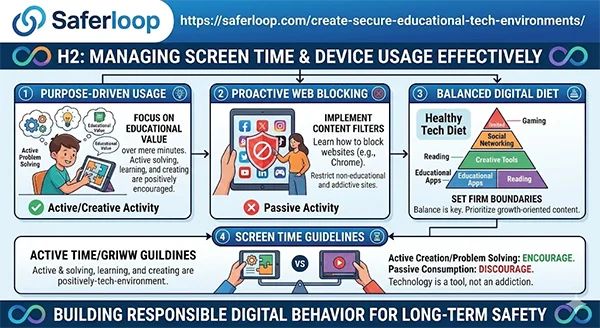
Further, here is an infographic that summarizes the key principles for establishing healthy rules around the use of AI tools in an academic setting.
Final Considerations: QuillBot or PlagiarismRemover.AI
Deciding between these two platforms is based on more than just their function; it is also based on their intent. If you want to assist your child in developing into an accurate and confident communicator, then QuillBot provides a more comprehensive set of tools for this purpose.
Using it improves writing, expands vocabulary, and includes a grammar checker that acts as an editor along the way. While PlagiarismRemover.AI’s name and primary function suggest that it promotes avoiding detection rather than developing new skills, its ultimate goal is to provide support for students finds difficulty developing their skills.
Frequently Asked Questions
Is there any risk of using a paraphrasing tool, like QuillBot, to identify your own work as being copied?
Will these tools make children reliant on them?
Yes, if they are used to replace creative thought, but should be used to aid decision-making—follow the guideline of “people first, machines second.”
Are teachers able to determine if students have used an AI tool?
Generally speaking, yes, in many cases, teachers can identify when a student’s writing differs from their normal style or abilities.
Is it more effective to prohibit all writing aids, including artificial intelligence?
No, a blanket prohibition does little to improve the situation. Instead, you should provide your students with guidance and open communication regarding using them so they will be well-prepared for the jobs of the future.
 Divya Kakkar
Internet Content Writer
About article
The author of this article Divya Kakkar, an Internet Content Writer at Saferloop, brings practical experience and industry knowledge to the subject.
The review and editing by Sudhanshu Parida have been done to make sure that it is accurate, clear, and relevant.
At Saferloop, we are determined to provide high-quality, well-researched, and updated content. To understand further how we produce and revise our articles, please refer to our Editorial Guidelines.
Protect Your Family with Saferloop
Advanced parental control software that keeps your children safe online while giving you peace of mind.
- Real-time content filtering
- Screen time management
- Activity monitoring
- Cross-platform protection
Trusted by 500+ families