

As per the rule, students’ 30% time should be spent getting directly tutored by the teacher, while the remaining 70% should be spent learning on their own through practice, discussions, problem-solving, etc.
×
Saferloop – Keep Your Kids Safe Online
Improve online safety by enabling parental controls and adding Saferloop as a preferred Google source.
What Should Parents Know About School Software Contracts

“Technology in the classroom is not the end goal. Enabling learning everywhere is the goal.” – Andrew Barras (Coach)
Tech is now an integral part of the classroom. Schools heavily use digital platforms in assisting educational activities, communication, and management. They can be simple classroom tools or comprehensive school-wide systems. These software features are mainly utilized for maintaining a student’s information and tracking students’ interactions with each other.
For parents, a little knowledge of how school software contracts work actually helps them not only ask the right questions but also advocate for the best use of the data. Even if one is not a lawyer, knowing the main points of a contract can disclose how a school safeguards its students.
In this article, I’ll expand upon everything that a parent should know about school software contracts.
Table of Contents:
- How Do Schools Choose Digital Tools?
- What Is Covered in a Data Protection Addenda?
- Which Clauses Matter Most to Families?
- What Happens When a School Stops Using a Platform?
- How Are AI Features Addressed in Modern Contracts?
- Questions Parents Can Ask School Leaders
- Making Sense of School Technology Agreements
- Frequently Asked Questions
How Do Schools Choose Digital Tools?
Schools usually follow official procurement procedures to choose any software. They can include:
- Issuing requests for proposals (RFPs)
- Making vendor presentations
- Conducting security assessments
- Engaging suppliers to finalize agreements
To get more information, parents should refer to general resources or even contact a contract lawyer who can explain the most common clauses in commercial software agreements. Such resources usually help clarify the meanings of service levels, liability, and data ownership, which are pretty much the most popular terms. Even though parents are not the ones who go to the negotiating table directly, knowing the contract setup makes community discussions more productive.
What Is Covered in a Data Protection Addenda?
Data Protection Addendum, or DPA, outlines how the software vendor collects, stores, and uses student information. Cybersecurity is important for kids everywhere.
The following infographic lists all the key DPA clauses:
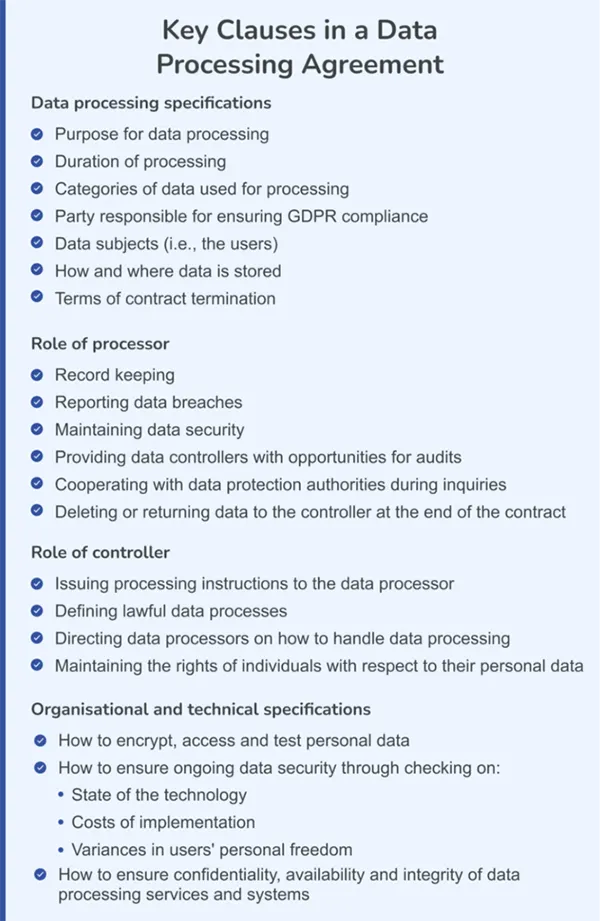
As a rule, the main issues are what type of data can be disclosed, how the data is secured, and whether the data can be used for purposes other than education. Usually, it is at schools that the burden of complying with privacy laws falls, though the exact requirements may change based on the vendors and systems involved. What an effective DPA must do is set data-use limitations and some security measures. This prevents things like unauthorized access.
Which Clauses Matter Most to Families?
Some contract clauses have a straightforward and immediate effect. For example, data deletion times are critical because they indicate the duration for which student information is retained after use.
Another critical part of the package is audit rights. These rights give the school power to verify that the vendors are implementing the promised measures, e. g., security safeguards, proper data handling, etc.
What Happens When a School Stops Using a Platform?
Offboarding, or contract termination, is a crucial aspect but often overlooked. When a school stops using a platform, the agreement should specify what happens to student data.
There should be explicit standards for vendors to return/eliminate all collected data within a certain time frame. Also, a school has to confirm that subcontractors or third-party partners are not holding onto any copies. If a proper offboarding agreement is lacking, confidential information might be retained forever.
How Are AI Features Addressed in Modern Contracts?
AI has deeply entered education. Such features could check learners’ progress, provide tailored instruction, or even automate operational tasks.
Contracts should clearly specify if the AI systems are allowed to use the student data for their own training or improvement. If true, they should impose limitations and require anonymization or explicit consent. Without these safeguards, student data could be used in ways that the families don’t even expect.
Questions Parents Can Ask School Leaders
You don’t need to review contracts line by line to be informed. Asking a few targeted questions can provide valuable insight into how student data is managed.
Questions could revolve around the duration of data retention, whether the provider is allowed to share information at all, overall kid internet security, and how regularly security practices are monitored. Asking about offboarding processes and the usage of AI may reveal the existing loopholes.
Making Sense of School Technology Agreements
Software contracts may seem complicated, but they are very important for safeguarding students. With an increasing amount of technology being used in schools, these contracts determine the rules for processing data and the functioning of systems.
Understanding, at least, the fundamentals of purchasing, privacy safeguards, and the elements of a contract can make parents feel more assured when discussing school technology.
Frequently Asked Questions
What is the 70/30 rule in teaching?
What are the red flags for a teacher?
Teacher red flags can be behavioral (texting a child), professional (poor teaching planning), and cultural (Constant disrespect for colleagues).
What are the 3 Cs of learning?
The 3 Cs of learning are: Challenge, Choice, and Consequences.
What expectations do parents have of school?
Parents expect schools to provide a safe environment for their child to develop disciplined and positive behaviour.
 Neha Sharma
Parental Control & App Safety Writer
About article
The author of this article Neha Sharma, an Parental Control & App Safety Writer at Saferloop, brings practical experience and industry knowledge to the subject.
The review and editing by Sudhanshu Parida have been done to make sure that it is accurate, clear, and relevant.
At Saferloop, we are determined to provide high-quality, well-researched, and updated content. To understand further how we produce and revise our articles, please refer to our Editorial Guidelines.
Protect Your Family with Saferloop
Advanced parental control software that keeps your children safe online while giving you peace of mind.
- Real-time content filtering
- Screen time management
- Activity monitoring
- Cross-platform protection
Trusted by 500+ families