
Some of the barriers that prevent parents from monitoring online behaviour effectively are digital skill gap, time constraints, and children’s want of privacy.
×
Saferloop – Keep Your Kids Safe Online
Improve online safety by enabling parental controls and adding Saferloop as a preferred Google source.
Group Chat Safety Is More Than Privacy Settings: What Parents and Kids Should Agree on Before Problems Start
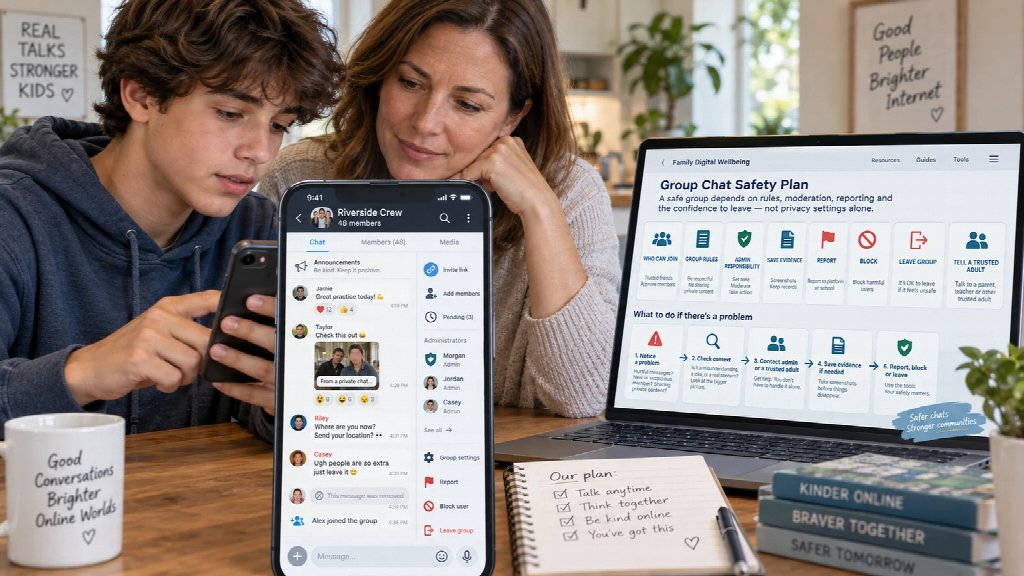
In today’s hyperconnected world, where digital connectivity is taking place, group chats are becoming new normal. And with these group chats, children are becoming vulnerable to bullying, humiliation, and specific jokes. These not only affect children mentally but also create some safety and privacy concerns.
Privacy and parental controls help in keeping a check on children’s activity online and also protect them from becoming specific targets. Privacy settings are still essential. So are account security, careful sharing, and knowing how to block or report an account.
Table of Contents:
- A Group Chat Can Change Character Surprisingly Quickly.
- Start With a Simple Question: Who Is Actually in the Group?
- Set Expectations Before Something Goes Wrong
- An Administrator Is Only Useful If They Actually Moderate
- “It Was Only a Joke” Can Hide a Pattern
- Screenshots Can Be Evidence — or Part of the Harm
- Give Children an Exit Plan Before They Need One
- Leaving a Group Can Carry a Real Social Cost
- Moderation Is Not the Same as Reading Every Message
- Use an Escalation Ladder Instead of Treating Every Problem the Same Way
- Public Invite Links Deserve Extra Attention
- Build a Short Family Group-Chat Agreement
- A Simple Scenario Exercise Can Reveal Gaps in Family Judgment
- Safer Groups Depend on People, Not Just Settings
- Frequently Asked Questions
A Group Chat Can Change Character Surprisingly Quickly.
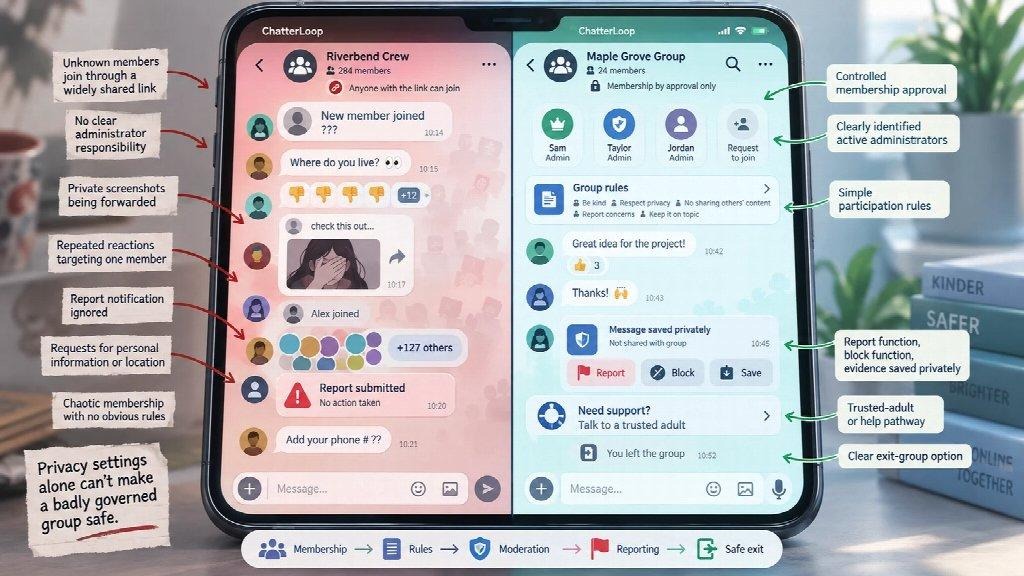
It may start as a place where classmates share homework reminders, jokes, photos from school events, or plans for the weekend. A few weeks later, someone added a person nobody seems to know well. A private screenshot gets reposted. One child gets the target of the same joke over and over. Another is pressured to share a photo, a location, or data they would rather keep private.
By that point, the issue is no longer just whether a child has the right privacy settings.
The difficult question is whether the group itself is being run in a way that makes children feel able to set boundaries, report issues, and leave when necessary.
Privacy controls are important. So do account security and careful sharing. But none of those tools can make up for a group where membership is badly controlled, administrators ignore problems, or bad behavior is treated as normal.
For parents, that means group-chat safety requires going beyond settings menus. It also needs rules, moderation, an escalation path, and a realistic exit plan.
Start With a Simple Question: Who Is Actually in the Group?
Before discussing what children should or should not post, it helps to determine who has access to the conversation.
A small chat among five classmates is quite different from a group whose invitation link has been forwarded repeatedly. A school-run communication link is also different from a group created informally by students, even if both have many of the same people.
Useful questions include:
- Who created the group?
- Who can add new members?
- Are the administrators people the child actually knows?
- Can anyone join through a public invite link?
- Are there members whose connection to the group is unclear?
Children do not need to think that every unfamiliar account is dangerous. But they should know that “a friend of a friend” is not the same thing as “someone I know and trust.”
That difference becomes more important as a group grows. In a small chat, members can usually tell who belongs there. In a large community, it becomes much simpler for an unknown person to involve themselves without anyone stopping to ask why they are present.
Set Expectations Before Something Goes Wrong
Families frequently discuss group rules only after a problem appears.
That is understandable, but it is often easier to agree on boundaries before a child is dealing with embarrassment, peer pressure, or an argument.
A useful family conversation might include a handful of basic expectations:
- do not add strangers casually;
- do not share another person’s private screenshots for entertainment;
- do not post someone’s home, school, or live location without a clear reason;
- do not pressure people to send photos or personal information;
- do not circulate sexual, violent, or otherwise inappropriate material;
- stop when someone clearly says a joke or comment is making them uncomfortable.
The point is not to write a miniature terms-of-service document for every chat. Children are not likely to remember a long policy anyway.
What helps more is giving them a picture of what a well-run group should feel like: people know why they are there, boundaries are understood, and somebody takes responsibility when those boundaries are mentioned.
For families who use Telegram-style communities and want a concrete starting point for that discussion, a 紙飛機家庭群組安全指南 can be useful for reviewing group roles, membership, and basic participation boundaries together.
The key part is what happens after the conversation. A rule that exists only in theory will not help much if nobody knows what to do when it is broken.
An Administrator Is Only Useful If They Actually Moderate
Many big chats display one or more administrator accounts. That can make a group look organized, but the label itself tells parents very little.
Moderation is a behavior, not a badge.
In practice, an active administrator may need to eliminate harmful material, review reports, manage membership, stop repeated targeting of one person, and reply when the same member keeps crossing agreed boundaries.
The bigger the group, the more this matters.
A chat with 100 members and three administrators can still be efficiently unmanaged if nobody responds to complaints. On the other hand, a smaller group with one attentive person may have clearer expectations and faster intervention.
Children should know whether there is an actual person they can contact if something becomes uncomfortable. Parents can talk about strangers without needing access to every message.
That easy question — “Who would you go to if something happened in the group?” — actually tells you more than asking whether the group technically has an admin.
“It Was Only a Joke” Can Hide a Pattern
A lot of group-chat harm does not arrive in the form of an actual threat.
It might look like a meme, a sarcastic comment, an edited photo, a reaction emoji, or a screenshot shared with a caption. One message may seem minor on its own.
Patterns matter more.
If the same child is repeatedly singled out, if other members group in, or if someone has asked for the behavior to stop and it continues, the context has shifted. What looks like “banter” to one person may feel like humiliation or exclusion to another.
That does not mean every unusual joke is bullying. Children and teenagers will sometimes annoy one another, misread tone, or argue.
Parents and moderators should pay attention to repetition, power imbalance, social pressure, and the child’s reaction instead of trying to classify every individual message in isolation.
It is also worth reminding children that joining in does not require writing the actual insult. Forwarding a post, reposting a screenshot, or repeatedly reacting to humiliating content can help turn one comment into a group pile-on.
Screenshots Can Be Evidence — or Part of the Harm
Screenshots are one of the most important and most easily misused tools in an online conflict.
There are situations where preserving a message is sensible. If a child is getting repeated harassment, threats, impersonation attempts, or inappropriate requests, a screenshot may help a parent, school, moderator, or other responsible adult understand what happened.
The problem starts when evidence becomes entertainment.
A private message that actually reached a handful of people can spread through an entire school year if it is repeatedly captured and forwarded. The person redistributing it may say they are “just showing what happened,” even when the practical outcome is further humiliation.
A useful family rule is easy:
Save what you need to report a problem. Do not keep circulating it.
Children can also be encouraged to show evidence directly to the person who should see it instead of reposting it in another group.
That distinction is worth teaching early because the social pressure to share screenshots can be strong, particularly when everyone else appears to be doing it.
Give Children an Exit Plan Before They Need One
When a group becomes uncomfortable, children usually have several options: mute the conversation, block an account, leave the group, report a user, preserve actual evidence, or speak to an adult.
The hard thing is that stressful situations are a poor time to explain those options for the first time.
Parents can make the process simpler by talking through a few hypothetical examples.
What would you do if an unknown adult sent you a private text after seeing you in a group?
What if classmates kept asking you to share your live location?
What if an embarrassing image was being reposted?
What if somebody asked for a login or verification code?
The value of these conversations is not that every family must pick the same response. It is that a child already has a mental script when something happens.
That minimizes the chance that fear, embarrassment, or uncertainty becomes the reason they stay silent.
Leaving a Group Can Carry a Real Social Cost
Adults often say, “If you don’t like the group, just leave.”
Technically, that may be possible. Socially, it can be more complicated.
For teenagers, group chats usually overlap with school friendships, sports teams, clubs, and weekend plans. Leaving can raise important questions. A child may worry about missing information, being left out the next day, or becoming the subject of new jokes.
Parents should not dismiss that thought.
At the same time, children need to hear that remaining in a group is not an obligation. If a chat repeatedly makes them anxious, embarrassed, or pressured, leaving can be a completely reasonable boundary.
Sometimes muting is enough and leaving makes sense. In a more serious case, it may be better to keep evidence and tell an adult before exiting.
The response should fit the situation instead of following one rigid rule.
Moderation Is Not the Same as Reading Every Message
There is a key difference between keeping a child safe and trying to observe every conversation they have.
Parents may require more visibility when there is a specific concern, especially with younger children. But long-term safety relies on children learning how to recognize problems themselves.
A better framework combines age-appropriate supervision with clear expectations:
- What kinds of behavior should be reported
- What information should not be shared casually?
- Who to contact when a group feels unsafe
- What an administrator should do
- When it is acceptable to leave
The same principle applies to people handling larger communities. Good moderation does not mean watching every simple conversation. It means creating predictable rules and responding consistently when members cross them.
For users who manage larger Telegram communities, a Telegram 群組管理指南 can provide a practical reference when reviewing administrator responsibilities, participation rules, and membership controls.
That kind of structure matters because users should not have to resolve every serious conflict on their own.
Use an Escalation Ladder Instead of Treating Every Problem the Same Way
Not every disagreement should get a school safeguarding case. Not every insult needs a platform report.
But the opposite approach — telling children to manage everything themselves — can be equally unhelpful.
Families can use an easy escalation ladder.
A one-off disagreement between friends may be something the children can tackle themselves.
Repeated targeting or harassment may justify including a parent or group administrator.
If the behavior includes classmates and is affecting school life, it may need to be raised through the school’s safeguarding or disciplinary process.
Threats, exploitation, credible safety risks or potentially illegal material may need reporting to the platform or an appropriate authority, depending on the circumstances.
The value of an escalation ladder is that it offers children somewhere to go next.
They do not need to decide whether a condition is “serious enough” in the abstract. They only need to know the next person they can tell.
Public Invite Links Deserve Extra Attention
Invite links are convenient, particularly for larger groups. They are also easy to forward.
A link intended for one class, club, or local community can immediately reach people outside the original audience. Once that happens, administrators may no longer know how new members found the group.
For groups involving children, it is good to review access periodically.
If an invite has spread too quickly, an administrator might replace it, introduce member approval, eliminate accounts that no longer belong there, or tighten moderation.
The real controls depend on the platform.
The broader principle does not: access should match the purpose of the group.
Build a Short Family Group-Chat Agreement
A family agreement does not need to be long to be useful.
In fact, shorter is often better.
| Situation | Family Agreement |
| An unknown member appears | Ask who they are rather than assuming they belong |
| Someone asks for a live location | Do not share home or school location just casually |
| A private screenshot is circulating | Don’t forward it for entertainment |
| Bullying keeps repeating | Save necessary evidence and tell a trusted adult |
| Someone asks for a login code | Never share it with anyone |
| A group gets uncomfortable | Muting, blocking, reporting, or leaving are better options |
| A serious incident happens | Know which parent, administrator, school contact, or platform channel to use |
The agreement should change as the child grows up.
A 10-year-old in a supervised activity group needs several boundaries from a 16-year-old who participates in several large communities. The aim is not permanent parental control. It is gradually better judgment.
A Simple Scenario Exercise Can Reveal Gaps in Family Judgment
Parents do not need to check a child’s real conversations to learn where their own online safety blind spots are.
Try using fictional conditions instead.
For instance:
- An unknown account joins a class chat
- A child is continuously mocked through screenshots
- Someone asks for a home address
- An adult sends a private message after seeing a child in a group
- A fake giveaway asks for account details
- A friend says, “Send me the code you just received”
- An offensive image keeps being reposted after someone asks for it to stop
Then question what each person in the family would do.
Ignore it? Talk to someone? Block the user? Contact an administrator? Tell the school? Report it to the platform?
The important part is often the disagreement.
If one parent sees a situation as harmless and another thinks it needs immediate action, that is a sign the family needs a better shared standard. Those gaps are much easier to work through in a fictional scenario than in the middle of an actual incident.
Safer Groups Depend on People, Not Just Settings
Privacy settings are still essential. So are account security, careful sharing, and knowing how to block or report an account.
But they are just part of group-chat safety.
A child can have great privacy settings and still be in a group where unknown members are added casually, screenshots are used to humiliate someone, administrators do nothing, and leaving carries heavy social pressure.
That is why families should also talk about how groups are governed.
Who is allowed in? What happens when someone crosses a line? Who can a child contact? When should evidence be saved? When is leaving the right choice? When does a problem need to move beyond the group itself?
Parents do not need to check every sentence their child writes to answer those questions well.
What children need most is a good understanding of boundaries, confidence that they can ask for help, and a practical way to respond when an online group doesn’t feel safe.
Frequently Asked Questions
What barriers prevent parents from monitoring online behaviour effectively?
How to protect kids from online dangers?
To protect kids from online dangers, there should be open communication, clear family rules, and safe technical safeguards.
What are good rules for a group chat?
Some of the good rules for a group chat are to ask members before adding someone, respect others, and not use any foul words.
 Neha Sharma
Parental Control & App Safety Writer
About article
The author of this article Neha Sharma, an Parental Control & App Safety Writer at Saferloop, brings practical experience and industry knowledge to the subject.
The review and editing by Evan Patterson have been done to make sure that it is accurate, clear, and relevant.
At Saferloop, we are determined to provide high-quality, well-researched, and updated content. To understand further how we produce and revise our articles, please refer to our Editorial Guidelines.
Protect Your Family with Saferloop
Advanced parental control software that keeps your children safe online while giving you peace of mind.
- Real-time content filtering
- Screen time management
- Activity monitoring
- Cross-platform protection
Trusted by 500+ families