
Not inherently. The quality and safety of a video depends on the creator’s process — whether there’s real oversight and consistency — not on whether AI was used to help make it.
×
Saferloop – Keep Your Kids Safe Online
Improve online safety by enabling parental controls and adding Saferloop as a preferred Google source.
What Parents Should Know About AI-Generated Kids' Content
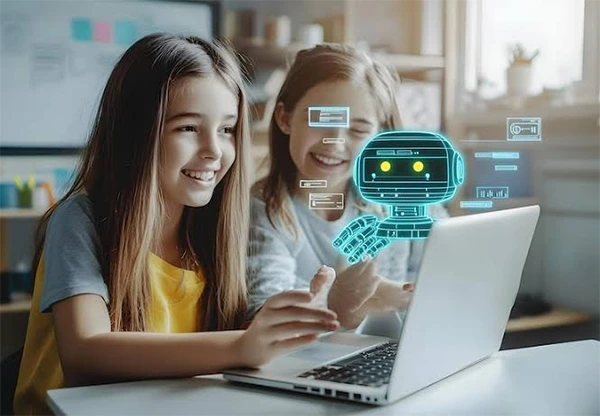
A growing share of what kids watch on YouTube and similar platforms today wasn’t filmed, drawn, or animated by hand. It was generated by AI — the script, the characters, the voices, sometimes the music too. Some of it sits alongside your child’s favorite traditionally made shows without any obvious label.
Most parents have no idea which is which. That’s the actual issue worth paying attention to, not AI itself. A cartoon isn’t automatically safer because a person drew every frame, and it isn’t automatically riskier because AI generated it. What matters is who’s behind it and how much care went into making it.
This article breaks down what AI-generated children’s content actually is, how to recognize it, and what questions are worth asking before you let your child watch a new AI-generated piece of content.
Table of Contents:
What “AI-Generated Children’s Content” Actually Means
In practice, it means a creator wrote or generated a script, then used AI tools to turn that script into a finished video — AI-generated characters and scenes, AI narration or voice acting, sometimes AI-composed music. No camera, no studio, no traditional animation team.
This is different from a deepfake or manipulated real footage. AI-generated children’s content is built from scratch as animation; it isn’t altering footage of a real person. The risk profile is different, too — the concerns here are less about deception and more about who’s actually overseeing what gets made and published.
How to Tell if a Video Was AI-Made
A few practical signs can help:
- Visual inconsistency. A character’s face, outfit, or art style subtly shifts between scenes or episodes.
- Voice cadence. Narration that sounds slightly flat, oddly paced, or inconsistent in tone from one video to the next.
- Channel patterns. A high volume of uploads, generic or formulaic titles, and little to no engagement with comments or community posts.
None of these signs alone means a video is unsafe. But they’re useful context, and the next section explains why consistency in particular is worth paying attention to.
Is AI-Generated Content Safe for Kids?
The honest answer: it depends entirely on the creator’s process, not on the technology itself.
The real risk isn’t AI-generated content in general — it’s fully automated “faceless channel” content published in bulk with no human review step in between. When a creator’s only goal is volume, scripts and visuals can go straight from generation to publish with nobody checking what actually ended up in the video.
The more reassuring pattern looks different. Some platforms are built specifically around a creator maintaining a consistent character, story, and visual style across every episode — reviewing and reusing the same character setup rather than generating something new and unsupervised each time. LongStories.ai, for example, is built around creators defining a character once and reusing that same setup across an entire story or series, which requires a creator to actually be involved in shaping the content rather than letting a pipeline run on its own. That kind of consistency is a byproduct of an actual creative process, not just a visual nicety — it’s a reasonable signal that a person is paying attention to what’s being made.
The takeaway for parents isn’t “avoid AI-generated content.” It’s “the same scrutiny you’d apply to any new channel still applies here — who’s making this, and does it look like anyone is paying attention.”
Questions Worth Asking Before You Let Your Kid Watch a New Channel
- Who is actually producing this — a named creator with a visible process, or an anonymous, fully automated pipeline?
- Does the content stay consistent from episode to episode, or does it feel randomly generated each time?
- Does the channel disclose AI use anywhere, even briefly?
- Are there real comments, replies, or community engagement — or does it look like nobody’s monitoring the channel at all?
These questions work for any new channel, AI-generated or not. AI just makes it easier for low-effort, unsupervised content to exist at scale, which makes asking them more important than it used to be.
Practical Tips for Parents
- Co-view new channels, at least for the first few episodes, especially with younger kids.
- Use your existing parental controls and content filtering as a baseline — they catch the same red flags regardless of how a video was made.
- Watch for the same warning signs you already know: clickbait titles, no creator information, no real audience engagement, and a publishing pace that looks more like a content farm than a show.
- Talk to your kids about what they’re watching, the same way you would with any new show — who’s it by, what’s it about, do they like it.
Conclusion
AI-generated children’s content isn’t inherently safer or riskier than traditionally made content — it’s a production method, not a safety category. The thing that actually predicts whether a channel is worth your kid’s time is the same thing it’s always been: whether a real person is behind it, paying attention, and putting in the work to make something consistent and worthwhile.
Tools and filters help. So does staying curious about what’s actually showing up in your child’s feed, and asking a few questions before hitting play on something new.
Frequently Asked Questions
Is AI-generated content bad for kids?
How do I know if a YouTube channel uses AI?
Look for visual inconsistencies between episodes, narration that sounds slightly off in pacing or tone, and channel patterns like very high upload volume with generic titles and little audience engagement.
Are AI-generated cartoons monitored for appropriate content?
It varies by creator and platform. Some creators maintain a consistent, reviewed process for every episode; others publish AI-generated content in bulk with minimal oversight. There’s no single standard across the category, which is why checking the channel itself matters.
Should I block AI-generated content from my child’s devices?
Not necessarily. AI-generated content isn’t automatically harmful. Instead of blocking it outright, use parental controls, review new channels, and apply the same safety checks you would for any content your child watches online.
 Aditi K
Freelance Cybersecurity Writer
About article
The author of this article Aditi K, an Freelance Cybersecurity Writer at Saferloop, brings practical experience and industry knowledge to the subject.
The review and editing by Vinithra Karunanidhi have been done to make sure that it is accurate, clear, and relevant.
At Saferloop, we are determined to provide high-quality, well-researched, and updated content. To understand further how we produce and revise our articles, please refer to our Editorial Guidelines.
Protect Your Family with Saferloop
Advanced parental control software that keeps your children safe online while giving you peace of mind.
- Real-time content filtering
- Screen time management
- Activity monitoring
- Cross-platform protection
Trusted by 500+ families