

AI cybersecurity awareness is important for kids because AI is already built into most apps and platforms kids use daily, which makes online risks harder to recognize without awareness.
×
Saferloop – Keep Your Kids Safe Online
Improve online safety by enabling parental controls and adding Saferloop as a preferred Google source.
Building AI Awareness and Increasing Your Kids' Cyber-Security to Avoid Online Dangers
The internet kids are growing up with isn’t the one most parents remember. It doesn’t just show content anymore. It reacts. Learns. Shifts what shows up next based on what you pause on, click, skip, or even scroll past without thinking. AI just makes all of that faster and harder to even notice.
The World Economic Forum has flagged AI-generated misinformation and synthetic media as a growing online risk, with fake images, voices, and videos now easy to create and spread, while Common Sense Media reports that many teens spend 7+ hours a day on screens. So this isn’t occasional internet use anymore, it’s daily life.
And the gap between kids and parents isn’t technical; it’s about understanding what’s behind the apps and not taking everything online at face value. This article will help you build AI awareness and strengthen your kids’ cybersecurity.
Table of Contents:
- Why AI Cybersecurity Awareness Matters for Kids
- Common Online Dangers Kids May Face in the AI Era
- Teaching Kids to Recognize Suspicious Online Behavior
- Building Safe Password and Privacy Habits
- How Parents Can Use AI Safety Tools and Monitoring Features
- Helping Kids Build Confidence to Report Online Threats
- Conclusion
- Frequently Asked Questions
Why AI Cybersecurity Awareness Matters for Kids
A lot of online safety advice still sounds like it came from a different internet. Don’t talk to strangers or click suspicious links is all true, but incomplete now. Because most apps don’t feel risky anymore. They feel normal. Even friendly.
Kids are talking to AI chatbots that sound human, scrolling feeds that learn what they like, playing games that track behavior, and using apps that adapt to their attention and emotions. Nothing looks dangerous at first glance, and that’s the tricky part. It’s one of the reasons cybersecurity professionals are placing greater emphasis on digital awareness, not just traditional online safety rules.
AI awareness is really about one simple idea: not everything that feels personal online is actually personal. Sometimes it’s just systems reacting, automation keeping attention, or no human at all. And even that small shift changes things. Kids slow down. Question more. Less automatic trust.
Common Online Dangers Kids May Face in the AI Era

Online risks aren’t always obvious anymore. They don’t come as pop-ups or shady websites. They’re often blended into normal-looking experiences. This is why parents need cybersecurity solutions to help keep their children safe online.
- AI-generated fake content – Images, videos, and even voice notes can now be created or altered in minutes. What looks like proof might not be real, and most kids won’t pause to verify it.
- Grooming that doesn’t feel like grooming – It often starts normally, like chatting in games, shared hobbies, and casual jokes. Nothing suspicious, but boundaries can shift slowly over time, which makes it harder to notice early.
- Algorithm loops – What shows up next isn’t random. It’s shaped by attention. A few seconds of interest can lead to more of the same, affecting screen time, mood, and what kids are exposed to.
- Quiet data collection – Apps track things like watch time, skips, location signals, and interaction patterns. Most permissions get accepted without a second thought, so data builds up in the background.
- AI companions and chatbots – These systems are becoming more conversational and emotionally responsive. But it can blur the line between a tool and something that feels human.
Teaching Kids to Recognize Suspicious Online Behavior
Most kids don’t respond well to rules that are fear-based. If everything is labeled as dangerous, nothing really feels clear anymore, and they will stop paying attention. Instead, it works better to teach them patterns, especially the things that show up again and again in risky situations online.
Like messages that feel urgent, links that look suspicious, profiles with very little real identity, or casual chats that slowly start asking about private information. Instead of just saying don’t do this, parents can help kids shift the way they think about it: Does this feel normal for how people usually talk?
Over time, that kind of thinking becomes natural. Kids start noticing when something feels off, even without being told exactly what to watch for, and that’s what actually builds safer habits online.
Building Safe Password and Privacy Habits
This is one of those areas where simple habits actually matter more than advanced tools. A lot of account issues start with basic things.
So a few steady habits help:
- Don’t reuse passwords across apps
- Use longer passphrases instead of short, complex ones
- Keep personal details off public profiles
- Check privacy settings once in a while
- Turn off location sharing when it’s not needed
It also helps when kids understand what passwords are. Not just security codes, but more like keys to their digital space. Once that clicks, they usually take it more seriously.
How Parents Can Use AI Safety Tools and Monitoring Features
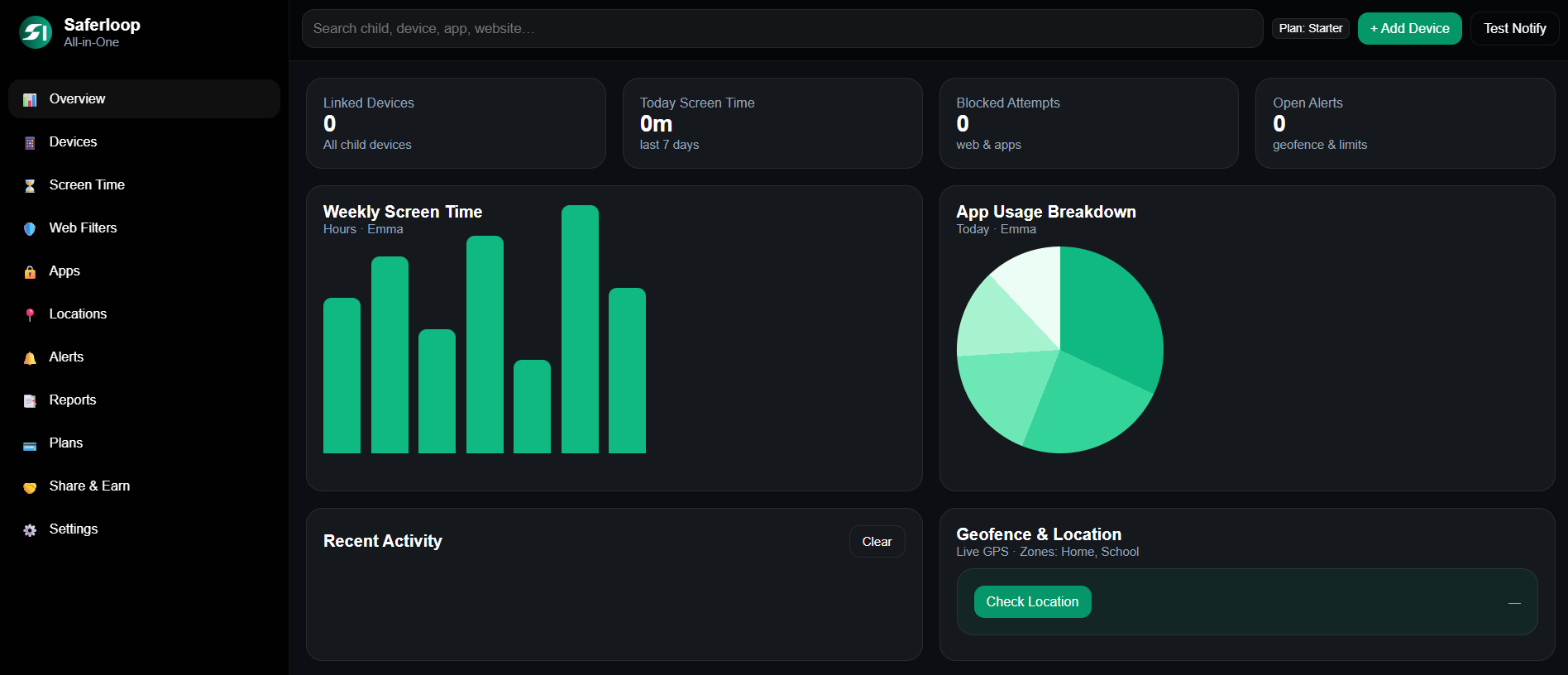
There are a lot of parental tools now that try to make digital parenting easier. Most include things like screen time controls, app usage tracking, content filters, location sharing, and activity reports. Platforms like SaferLoop try to bring all of that into one place instead of leaving parents to manage scattered settings across different apps.
But tools alone don’t solve everything. How they’re introduced matters just as much. If kids discover them later, it can feel like surveillance. But when parents are open about it, it feels more like structure and support.
Even a simple explanation to kids, this is just so we know what’s happening, and nothing goes off track, can completely change how it’s received.
Helping Kids Build Confidence to Report Online Threats

A lot of online problems don’t become “serious” immediately. They usually start small and grow when nothing gets said.
Kids often stay quiet because they don’t want to get in trouble, think they caused it, or aren’t sure if something is “serious enough” to mention.
That’s why communication matters more than most parental controls. And as AI becomes a bigger part of everyday internet use, awareness matters too. Resources like OffSec’s OSAI course are also helping people better understand how AI-driven systems and online risks actually work.
It helps to make reporting feel normal instead of dramatic. Simple reassurance like, “if something feels weird, just tell me,” or “even if you clicked something, we’ll figure it out together,” makes kids far more likely to speak up early.
And honestly, that’s usually what makes the biggest difference—because once something is shared early, it’s almost always easier to handle.
Conclusion
AI isn’t something kids will start using in the future. It’s already built into the apps, games, and platforms they use every day, often without even realizing it. And that shifts what online safety actually means.
It’s less about trying to block everything and more about helping kids understand what they’re looking at, how these systems work, and how to respond when something feels suspicious.
Some structure can help, such as tools, filters, and awareness training, which can be beneficial, but most of it still comes down to something simpler. Kids who can notice when something doesn’t feel right usually don’t need much rescuing later. They just pause, question it, or bring it up instead of ignoring it or pushing through. That’s really the goal: not the control, but awareness that builds quiet confidence over time.
Frequently Asked Questions
Why is AI cybersecurity awareness important for kids today?
How can parents teach kids to spot suspicious online behavior?
Parents can teach kids to notice when something feels rushed, secretive, unusual, or just not right, rather than only relying on strict rules.
Are parental control tools enough to keep kids safe online?
No, parental control tools can help with features like content filtering and monitoring, but communication, awareness, and trust between parents and kids are equally important.
 Divya Kakkar
Internet Content Writer
About article
The author of this article Divya Kakkar, an Internet Content Writer at Saferloop, brings practical experience and industry knowledge to the subject.
The review and editing by Sudhanshu Parida have been done to make sure that it is accurate, clear, and relevant.
At Saferloop, we are determined to provide high-quality, well-researched, and updated content. To understand further how we produce and revise our articles, please refer to our Editorial Guidelines.
Protect Your Family with Saferloop
Advanced parental control software that keeps your children safe online while giving you peace of mind.
- Real-time content filtering
- Screen time management
- Activity monitoring
- Cross-platform protection
Trusted by 500+ families