
Improve online safety by enabling parental controls and adding Saferloop as a preferred Google source.
Encrypted Fulfillment: Why Patching Is the Secret Sauce of Data Integrity

As an Internet security consultant, I have learned that the most critical movement in logistics and delivery is the data flowing through the system. Even if you are into order management for junk removal business, the integrity of your information remains the secret sauce. And the patching process is what protects this asset (secret sauce).
Ponemon Institutealso revealed that approximately 60% of all data breaches occur from unpatched vulnerabilities. In fact, hackers can exploit a known vulnerability within the days of its discovery. It is like you leave the volt door wide open while focusing on the high-tech cameras.
In this case, considering a stitch in time that can save nine becomes indispensable for streamlining operations. Therefore, I present this guide that explains ways to maintain the desired level of operations, along with protecting the data’s life cycle through timely updates.
KEY TAKEAWAYS
- Regular patching eliminates known security holes that “zero-day” exploits and automated bots target.
- Many data protection regulations mandate up-to-date software as a legal requirement.
- To fully benefit from patching, consider training staff, updating certificates, refining algorithms, and fixing logic flaws.
- Ensuring that the cryptographic protocols securing your information will provide resistance to modern-day brute force attacks.
Understanding Data Integrity in Modern Systems
Data integrity means assuring that information remains accurate, complete, and consistent throughout its entire life cycle. This means that when customers enter their address, payment information, and order history, that data will stay the same before and after making a purchase.
Every touchpoint must be hardened to allow the customer to deliver all the information you need as the order is placed. If any data alteration occurs, the entire chain of trust breaks down. Therefore, all of the touchpoints must be secured. That’s where we need a system that is sufficiently robust to resist unauthorised modifications and maintain the truth of the company’s business records.
What Patching Means in Secure Fulfillment Environments
The process of fixing a security or performance issue within an encrypted fulfilment system via a software upgrade is known as patching. Over time, there will always be new vulnerabilities with increasing technology. In this situation, developers identify and reinforce the weak spots before hackers can find them.
Led by security professionals, the entire procedure involves:
- Security updates
- Feature updates
- Bug fixes
- Reducing downtime
- Regulatory compliance
In an environment where data is encrypted, patching is even more vital. If the software managing your encryption keys has a flow the encryption itself becomes moot. Ultimately, patching makes sure that the lock on your data is constantly being upgraded to stay ahead.
How Unpatched Systems Put Data at Risk
Automated tools are used by hackers to search the internet for outdated servers. Once a vulnerability is publicly disclosed, there is a race to exploit that vulnerability.
- Certain unpatched vulnerabilities allow attackers to execute their own code on servers, giving them full control of them.
- Outdated systems are weak, so attackers get an opportunity to bypass encryption and steal data.
- Most ransomware attacks occur through a known but unpatched remote desktop protocol or VPN vulnerability.
Overall, an unpatched system is like a time bomb, which needs to be deactivated before it explodes and exfiltrates data.
The Role of Regular Updates in Encrypted Workflows
Encryption is only one element of a secure environment. The second element is the environment in which the encryption exists. Regularly updating the system will improve the “health” of the encrypted workflow by:
- Training Staff: Everyone in the house becomes aware and is prepared for upcoming alterations.
- Updating Certificates: To deny man-in-the-middle attacks, consider having SSL / TLS certificates.
- Refining Algorithms: Replace older, less secure encryption methods with newer, stronger forms of encryption.
- Fixing Logic Flaws: By closing the gaps in the logic within the software, and therefore preventing an attacker from bypassing authentication checks altogether.
| INTERESTING FACT The term patching actually originates from early computing in the mid-20th century. Programmers would literally cover faulty holes on punched cards with tape (a physical patch) to fix bugs. |
Why Consistent Patching Strengthens Long-Term Security
Patching builds what is called digital resilience, indicating it’s a way to create a culture of ongoing maintenance for future protection of your business. Companies that focus on update maintenance also increase the cost of entry for attackers.
Most hackers specifically search for the low-hanging fruit, so they will generally attack systems that are outdated. One can elevate the tier of security, thus building trust with your customers, and you take data seriously.
Check out the infographic attached below to briefly understand the path followed in the patching process to enhance performance in every aspect:
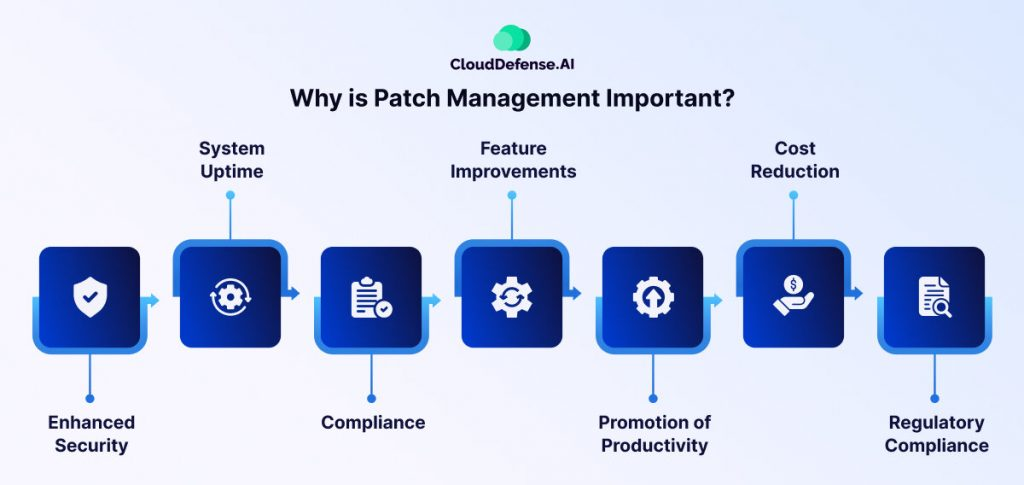
ALT: Importance of Patching Management
Source: Copied from the Internet
The Final Verdict
Patching works as a framework to fix bugs, boost performance, and most importantly, close security vulnerabilities in the data-oriented world. It may not be considered a substantial measure, but it is indeed an integral component of data integrity.
As Stéphane Nappo says, “It takes 20 years to build a reputation and a few minutes of cyber-incident to ruin it.” So don’t overlook the patching process; take precautions today to experience a safer tomorrow.
FAQs
Ques 1. Do you need to take down your system in order to patch it?
Answer. Not always, especially with live patch tools that can patch your kernel or applications without rebooting.
Ques 2. If I apply a patch, are there risks that my current software will break?
Answer. Yes, there are risks, so test patches in “sandboxes” or staging environments before deploying to your live fulfillment system.
Ques 3. How frequently should I look for patched applications?
Answer. You should immediately apply critical patches and perform a regular maintenance cycle for non-critical updates.
Ques 4. Will encrypting my data become useless if I do not patch?
Answer. Encryption has become severely compromised. Attackers can steal unencrypted data before encryption or access the key to decrypt encrypted data if the application used to encrypt the information has flaws.
Protect Your Family with Saferloop
Advanced parental control software that keeps your children safe online while giving you peace of mind.
- Real-time content filtering
- Screen time management
- Activity monitoring
- Cross-platform protection