
R Discovery is a world-class end-to-end literature discovery system with a large, growing database of 300M+ papers and a specialised Literature Review tool. Elicit is great where a systematic review is necessary and structured data extraction is required. ResearchRabbit is useful for creating maps and making citations.
×
Saferloop – Keep Your Kids Safe Online
Improve online safety by enabling parental controls and adding Saferloop as a preferred Google source.
The Best AI for Research That Can Save You Hours of Work

The use of artificial intelligence is changing the face of research and making academic processes more efficient and effective. Today, I will take you through the best AI research tools and how they can save you many hours of work. These best AI for research tools will revolutionise your academic workflow, from getting started with a relevant paper to comprehending complex studies. Learn how AI for research can supplement your work at every step of the process, from literature discovery to paper analysis to evidence synthesis to citation management.
Introduction
Discovering quality research papers tends to take much longer than expected and makes learning both difficult and time-consuming. Luckily, AI is revolutionizing the research process and assisting learners in finding papers, analyzing their content, and managing citations.
According to a 2025 report by Wiley, the number of researchers using AI grew from 57% to 84% within just one year. In this guide, we will review the top AI tools for research in 2026, paying attention to the tools that can be used for literature discovery, analysis of papers, synthesis of evidence, and referencing. You will learn how to compare various AI research tools and choose the ones you need.
Key Points Covered in This Blog
- Find the most effective AI research tools that can cut up to 70% of the time spent on research.
- Understand how AI research tools can enable the discovery of literature, analysis of papers, and citation management in one go.
- Learn how to compare some of the best AI tools for academic research in the academic field, such as R Discovery, Elicit, Consensus, and more.
- Describe the advantages of using AI for literature review, which can save you weeks of effort in mere days.
- Find out about systematic review and evidence synthesis research supported by AI-powered research tools.
- Get hands-on guidance on responsible and ethical use of AI research paper analysis tools and AI citation/referencing tools
Why Your Research Workflow Needs AI in 2026
The traditional way of doing research is no longer sufficient. Previously, you had been searching databases for a week or two and formatting citations by hand. However, the advent of AI research tools has revolutionised everything. (Albogunrin et al. 2025) Demonstrate that AI can save more than half the time spent on abstract review and up to 60 hours on literature review. From finding papers to formatting references, these smart tools will help you save a lot of time and effort in doing research as well as formatting references using their unique features. Let us find out how the best AI tool to improve the research process is going to change your workflow.
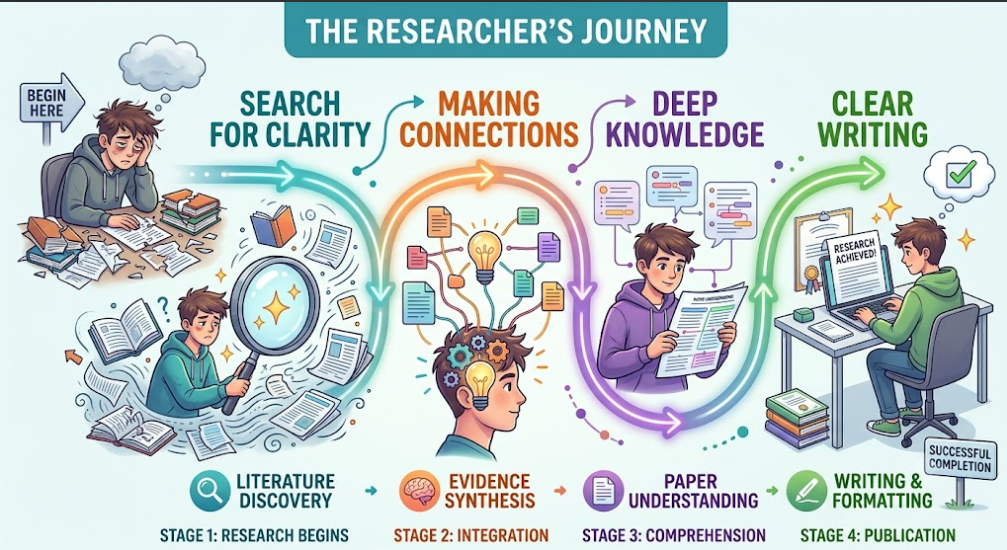
Take a step-by-step look at how AI for research can save you valuable time throughout your workflow:
| Research Stage | What AI Does for You | Time Saved |
|---|---|---|
| Literature Discovery | Finds relevant papers without endless searching | Hours |
| Evidence Synthesis | Connects findings across multiple studies | Days |
| Paper Understanding | Provides clear summaries of complex research | Hours |
| Writing & Formatting | Polishes your work and handles citations | Hours |
Tools such as ChatGPT, Claude, and Perplexity are useful for many reasons in the research process, primarily because they can analyse vast datasets and generate insightful summaries. However, not all AI research tools are equally effective. So it is worth looking at the differences between the good and the great.
What Makes a Great AI Research Tool?
So, what kind of features should one expect from AI tools for academic research? These are the four essentials to look for:
| Feature | What It Means | Why It Matters |
|---|---|---|
| Reliable Retrieval | Pulls from trustworthy, peer-reviewed databases | No fake sources or made-up citations |
| Long-Context Reasoning | Remembers entire studies, not just snippets | Understands the full picture, not just pieces |
| Multimodal Capabilities | Works with text, audio, and visuals | Handles different types of research content |
| Collaboration Features | Let’s build knowledge together | Share insights with colleagues easily |

The problem is that academics cannot work with hallucinated data or fabricated citations; That is a deal-breaker. In addition, be aware of tools that search a single database rather than multiple databases. Too many valuable papers will be missed. You would miss out on many valuable articles. Here are the best AI academic research tools that cover everything.
The Best AI for Research: A Comprehensive Comparison
We have broken down the best AI research tools for 2026 to help you decide which one to use.
| Tool | Best For | Database Size | Key Feature | Free Plan |
|---|---|---|---|---|
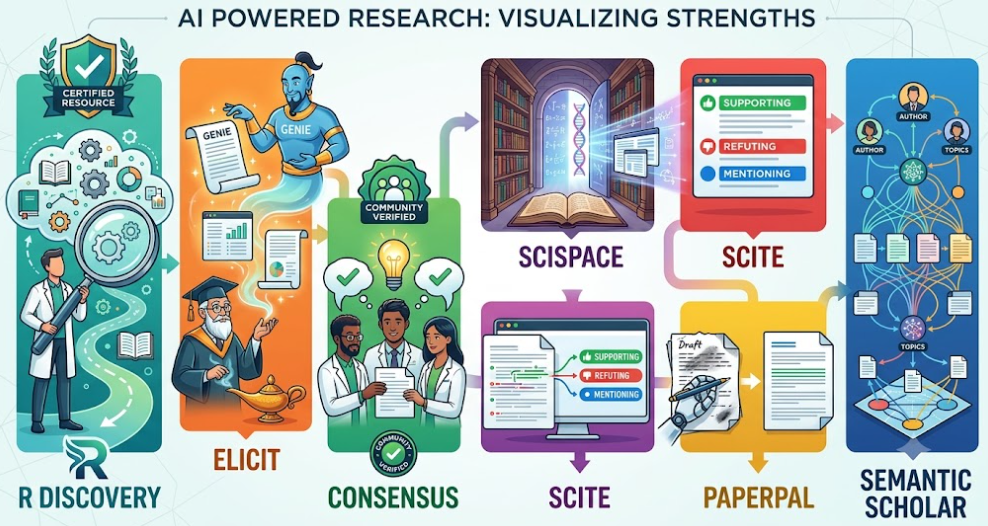
| R Discovery | Literature discovery & review | Approximately 300M+ papers, 32K+ journals | Personalised AI feed + Literature Review + Audio Papers | Yes |
| Elicit | Systematic reviews & data extraction | As per Provider 138M+ papers, 545K+ clinical trials | Automated screening & extraction | Yes (limited) |
| Consensus | Evidence-based answers from peer-reviewed research | As per the Provider, approximately 200M+ papers | Consensus Meter for scientific claims | Yes (limited) |
| SciSpace | All-in-one research workspace | Approximately 280M+ papers | AI Agent with 150+ integrated tools | Yes |
| Scite | Citation analysis & reference checking | Approximately 1.2B+ Smart Citations | Supporting vs contrasting citation context | Trial |
| Paperpal | Academic writing & editing | Approximately 250M+ papers | AI Reference Finder + Citation Generator | Yes |
| Semantic Scholar | Free academic paper discovery | Approximately 200M+ papers | AI-powered literature search | Yes |
The Standout Stars
Take a moment to understand why each of these AI tools for literature reviews is unique:
R Discovery
R discovery claims to save up to 70% of wasted search time. It has access to more than 300 million papers published in 32,000+ journals, which is basically the same as having a research assistant that works non-stop.
Elicit
Elicit removes much of the manual screening, leveraging semantic search powered by a large language model to search across 138 million citations. Excellent choice if there are too many papers that need to be sorted through, and you do not have enough time to actually read them all.
Consensus
Consensus acts as the fact-checker you have always wanted! It provides access to peer-reviewed literature from Semantic Scholar. It presents you with the Consensus Meter, which shows you if there is a consensus within the scientific community about the topic you are exploring.
Paperpal
Paperpal is the writing partner of the group. Having trained on a dataset of millions of scientific research articles, this will help you write with precision and strip out the clichés and grammatical errors that weaken the academic prose.
The General-Purpose Heroes
Do not forget all-rounders. Each of these AI tools- ChatGPT, Deep Research, Claude, Gemini, and Perplexity is useful in your research stack. They are useful for brainstorming, summarising, and when you are stuck and need some inspiration while writing. With the players introduced, we can look at the ways these AI research tools can assist you in doing a literature review from another angle.
AI for Literature Reviews: Your Time-Saving Superpower
Among the time-consuming parts of research projects, literature reviews are at the top of the list. With the advent of AI for literature review tools, however, this process has been revolutionised. The role of these tools is best described when classifying them according to their intended use.
During discovery, R Discovery’s Literature Review tool identifies relevant papers and aggregates important findings into a single place; Research Rabbit helps find the relationships among papers and authors that you probably missed through its visual citation maps. Among AI tools for systematic reviews, Elicit automates screening and extraction; PrismAId uses AI to screen and extract data without coding; and Rayyan uses AI and machine learning to screen data rapidly.
Google Scholar Labs uses AI to surface suggestions and highlight the essential topics in your query, and OpenScholar searches 45 million open-access papers to provide citation-backed answers.
AI for Paper Analysis and Understanding
Reading dense academic papers can be a headache; you can invest hours just trying to work out what the authors mean. That is where AI research paper analysis tools can help out, though. Explainpaper is a genuine game-changer. Upload a PDF, mark the hard-to-understand parts, and get simple explanations in everyday language from the AI. Many AI research assistants have adopted the Chat PDF feature in their offerings today. Upload research papers and ask follow-up questions about methods, findings, or terminology. R Discovery, Paperpal, and SciSpace all allow you to upload any paper and then consistently follow up with questions. Want to learn about the method? Just ask. Looking for a Summary? Ask for one. Google’s NotebookLM can summarise information from your notes, create study guides, and provide answers to your questions based on the content in your notes. Some advanced AI research paper analysis tools are able to create a research paper review without human interaction at all.
AI for Citation and Referencing: Never Format a Bibliography Again
Formatting citations by hand is tedious and time-consuming, and one botched resource can make all the difference in the world to a really impressive reference list. However, AI citation and referencing tools have made this process far easier. Paperpal has a built-in Citation Generator that supports over 10,000 styles, as well as an AI Reference Finder that searches more than 250 million articles. R Discovery provides a Citation Generator for APA, MLA, Chicago, and Harvard citation styles. Scite not only identifies who referenced a paper, but also indicates whether they supported or disagreed with it. Scholar Sidekick converts DOIs to formatted citations and reports the status of the retraction. Even so, always double-check the references. While AI citation and referencing tools are of great assistance, do not rely on them entirely; they should always be cross-checked with the actual publication and your institution’s referencing manual. There is no such thing as a perfect AI tool.
How to Use AI Ethically in Research (For Students and Academics)
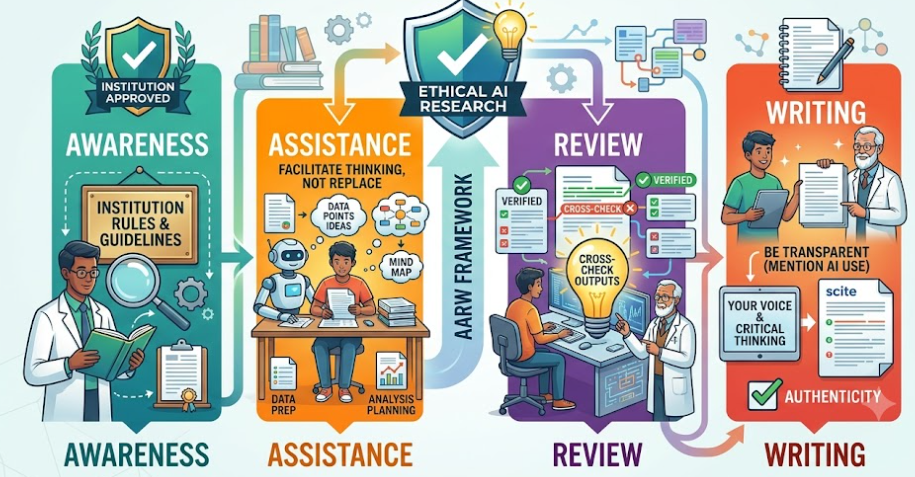
The ethical use of AI for research purposes is one of the hot topics nowadays, and this is understandable. This is a simple structure to follow: the AARW Framework (Awareness, Assistance, Review, Writing).
- Awareness: Understand the rules and guidelines for using AI within your institution.
- Assistance: Be a helpful research assistant; use AI as a tool to facilitate thinking, not replace it. Let it handle the discouraging tasks for you so you can focus on analysis. Always cross-check the information generated by AI. Always check the outputs.
- Review: Investigate sources and confirm facts in the AI-generated claims.
- Writing: Be transparent. Mention it in your work when necessary if you have created something using AI.
Students should keep in mind that the purpose of the question, ” How can students use AI ethically for research”, is not about using AI as a shortcut, but about using it wisely. It is important that your own voice and critical thinking come through at all times!
And if the workload is still heavy after automation, the research paper help team at The Academic Papers UK can take the drafting and referencing burden off your shoulders, with you staying in charge of the thinking.
Conclusion
The best AI for research in 2026 is the set of AI tools for evidence synthesis, discovery, analysis, and writing. You can also get perfect dissertation help, combined powerfully to support your full research processes. Utilise R Discovery or Elicit to do literature discovery, paper analysis tools, such as Explainpaper or NotebookLM for understanding, and Paperpal or Scite for citations. Together, these tools can cut up to 70% of the time spent searching. Choose one tool from this list today and measure the amount of time you save. You are not alone in looking for the best AI for research; the right answer is just waiting for you! And for the stages no tool can automate, The Academic Papers UK is a reliable place to start.
Frequently Asked Questions (FAQs)
Which AI tools are best for literature reviews?
Can AI help find research papers?
Absolutely. All AI for finding research papers is now mainstream: For example, with Elicit, you can semantically search more than 138 million papers; Consensus’ search results include only peer-reviewed literature, and Google Scholar Labs has an AI-powered search.
Can AI help find academic sources?
Yes, R Discovery includes trusted data sources such as PubMed, Springer Nature, Wiley, and SAGE, including 300M+ papers, while Paperpal can search more than 250M+ research articles.
Can AI assist with data analysis in research?
Yes, Julius AI supports the entire analytics process from data cleansing to visualisation and predictive forecasting. These two programs, NVivo and ATLAS.ti, offer structure to qualitative analysis.
How can students use AI ethically in research?
According to the AARW Framework (Awareness, Assistance, Review, Writing). Always check the output, correctly cite sources, identify when using AI is necessary for conformance, and never use AI-generated output in place of a student’s own critical thinking.
 Aditi K
Freelance Cybersecurity Writer
About article
The author of this article Aditi K, an Freelance Cybersecurity Writer at Saferloop, brings practical experience and industry knowledge to the subject.
The review and editing by Vinithra Karunanidhi have been done to make sure that it is accurate, clear, and relevant.
At Saferloop, we are determined to provide high-quality, well-researched, and updated content. To understand further how we produce and revise our articles, please refer to our Editorial Guidelines.
Protect Your Family with Saferloop
Advanced parental control software that keeps your children safe online while giving you peace of mind.
- Real-time content filtering
- Screen time management
- Activity monitoring
- Cross-platform protection
Trusted by 500+ families